THE IDEA IN ONE LINE
Gold can diversify reserves, but it earns no coupon and can fall in value. A bigger reported balance need not mean more metal was purchased.
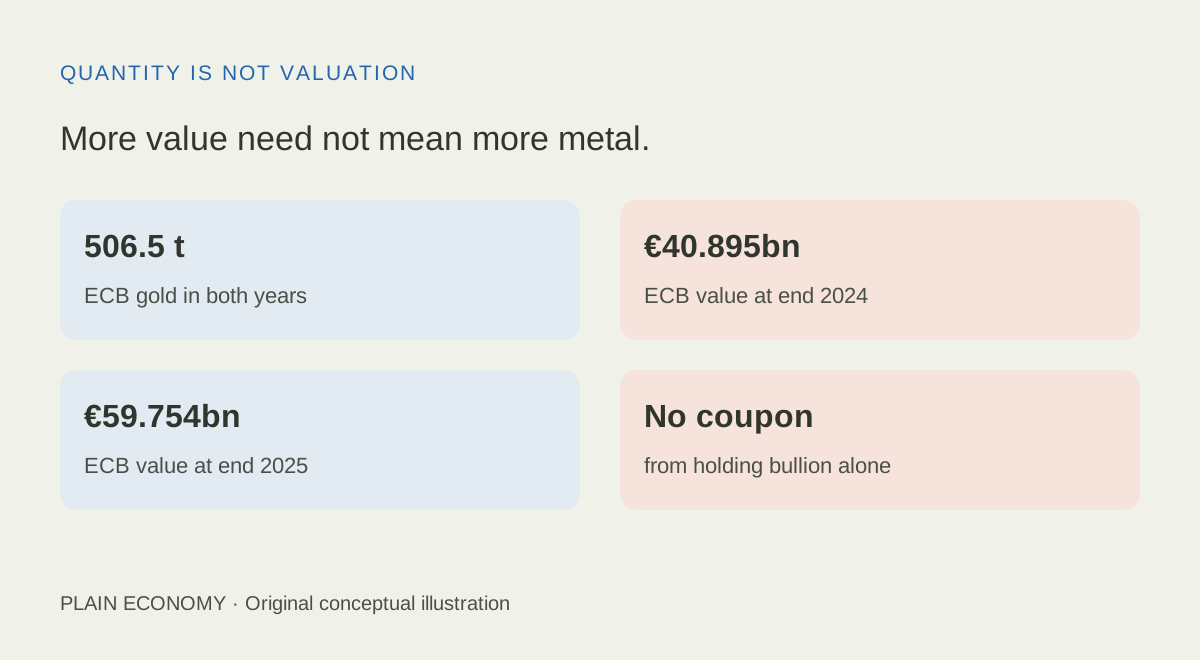
More value need not mean more metal.
506.5 tECB gold in both years
€40.895bnECB value at end 2024
€59.754bnECB value at end 2025
No couponfrom holding bullion alone
506.5 tECB gold in both years
€40.895bnECB value at end 2024
€59.754bnECB value at end 2025
No couponfrom holding bullion alone
A central bank can report a much more valuable gold reserve without buying one extra bar. It can also hold more gold while reporting a smaller dollar balance. Understanding either headline requires separating quantity from market valuation. The reason for holding the metal is another question again. Official reserves serve institutional needs such as liquidity and resilience; their composition is not a ready-made recommendation for a household's savings.
Bullion is different from another issuer's promise
The IMF defines monetary gold as qualifying gold owned by monetary authorities or entities under their effective control and held as a reserve asset. The category includes bullion and qualifying unallocated gold accounts. Physical bullion itself has no corresponding issuer liability. That distinguishes a bar from a bond promising repayment, but it does not remove price risk or the practical costs of owning and accessing it.
The qualifier matters. A gold fund, an unallocated claim, a derivative and a lending arrangement have their own structures and counterparties. A statement about bullion's lack of issuer default exposure cannot be applied automatically to every product with gold in its name. Private jewellery, mine inventories and household coins also do not become official monetary gold merely because they are within the same country's borders.
The ECB lists liquidity, security and return, in that order, as the objectives of its foreign reserve management. Gold is one part of its mix, alongside foreign currencies and other reserve instruments. An institution can value flexibility in adverse conditions even when another asset offers more current income. The appropriate question is what the reserve portfolio needs to do, not simply which asset recently rose most.
Quantity and valuation tell different stories
The ECB’s own 2025 accounts show 16,285,778 fine ounces at both end 2024 and end 2025, approximately 506.5 tonnes. The euro market value rose from EUR 40.895 billion to EUR 59.754 billion. This is the ECB institution itself, not all national central banks in the Eurosystem. Its accounts attribute the increase to the higher euro price of gold.
The same gold had a higher euro valuation
Observed ECB institution-only gold value, EUR billions, year-end. Zero baseline; 506.5 tonnes both years.
See the data
| Date | Fine ounces | Tonnes, rounded | Market value EUR bn |
|---|---|---|---|
| End 2024 | 16,285,778 | 506.5 | 40.895 |
| End 2025 | 16,285,778 | 506.5 | 59.754 |
The difference, EUR 18.859 billion, is a valuation comparison between two dates. It is not a cash coupon, proof of purchases or a measurement of realized trading income. For an unchanged quantity, the relevant variable is the gold price in the reporting currency. A dollar gold quotation and the euro–dollar exchange rate can jointly affect a euro-denominated balance.
China's official table provides a different combination. SAFE reports 76.73 million ounces in August 2026 and 77.47 million in September, while the dollar value falls from USD 350.080 billion to USD 323.517 billion. Reported quantity increases by 0.74 million ounces, or about 0.96%; reported value falls by USD 26.563 billion, or about 7.59%.
More reported ounces can accompany a smaller dollar value
Observed SAFE reported gold quantity, million ounces, month-end 2026. Zero baseline; dollar values appear separately in the table.
See the data
| Month-end 2026 | Reported million ounces | Reported value USD bn |
|---|---|---|
| July | 76.08 | 306.354 |
| August | 76.73 | 350.080 |
| September | 77.47 | 323.517 |
That does not establish a USD 26.563 billion trading loss. A reserve balance combines quantity and valuation; realized profit requires transaction prices and accounting information that this subtraction does not supply. The table's original quantity units are ten thousand ounces and its value units are one hundred million dollars. Converting both carefully avoids confusing ounces with tonnes or overstating the amounts by a factor of one hundred.
Even a quantity increase should be described with care. It establishes more reported reserve gold, without identifying every acquisition date, contract, ownership arrangement or motive. The September SAFE cutoff also differs from the August Treasury snapshot in our article on Chinese-attributed US debt. Two different series do not establish that a particular security sale financed a particular gold transaction.
Diversification is a reason to hold gold, not a guarantee
An ECB analysis discusses diversification and geopolitical concerns among reported motivations for gold demand. Some of its evidence draws on industry surveys and estimates. Those responses help explain stated preferences; they do not prove every central bank's motive, an undisclosed strategy or a plan to restore a gold standard. Official balances provide no audited count of supposed secret reserves.
To see the portfolio logic without a prediction, imagine EUR 100 million split between 80% other reserve assets and 20% gold. If the other assets fall 5% while gold rises 10%, the ending value is EUR 98 million, compared with EUR 95 million without gold. The metal cushions the decline under those assumed returns.
Diversification can help, hurt or fail to cushion a fall
Hypothetical ending portfolio values, EUR millions, starting from 100. Zero baseline; the 80/20 mix is illustrative.
See the data
| Scenario | Other assets return | Gold return | Without gold EUR m | 80/20 mix EUR m |
|---|---|---|---|---|
| A | −5% | +10% | 95 | 98 |
| B | +5% | −10% | 105 | 102 |
| C | −10% | −10% | 90 | 90 |
Reverse the signs: other assets rise 5% while gold falls 10%. The mixed portfolio ends at EUR 102 million instead of EUR 105 million. If both lose 10%, each portfolio ends at EUR 90 million. Diversification changes the combination of exposures; it does not force them to offset each other. The 20% weight is a teaching assumption, not an optimal allocation or a household prescription.
Access and costs remain part of the decision
The ECB’s reserve-gold presentation lists volatility, lack of remuneration and storage costs among gold’s limitations. Bullion earns no coupon just by sitting in a vault. Lending or swapping it is a separate activity with additional terms and exposures. A higher market value should not be confused with recurring cash available to meet operating bills.
Location matters for access, settlement and legal arrangements, but it is not the same as ownership. The Bank of England holds allocated bars for customers who retain title to their particular gold; that customer gold is not on the Bank’s own balance sheet. Overseas custody can support access to a trading market. Domestic storage and foreign custody each involve trade-offs; neither location by itself proves immunity from disruption.
A useful gold headline therefore needs four labels: whose gold, how much metal, its valuation currency and date, and the reserve objective. Rising value is not automatically accumulation, and accumulation is not evidence that the asset cannot lose money. The institutional case for holding a reserve mix rests on its intended function across conditions, rather than on treating yesterday's gold rally as tomorrow's promise.
Optional: reproduce the original calculations
Reserve gold value = quantity × price in the reporting currency. ECB change: 59.754 − 40.895 = 18.859 EUR billion. SAFE quantity change: 77.47/76.73 − 1 ≈ 0.9644%; value change: 323.517/350.080 − 1 ≈ −7.5877%. In scenario A, 80 × 0.95 + 20 × 1.10 = 98. In B, 80 × 1.05 + 20 × 0.90 = 102. In C, 80 × 0.90 + 20 × 0.90 = 90, all in EUR millions.
Sources and method
- IMF BPM6: monetary gold, chapter 5
- ECB: foreign reserves and management objectives
- ECB: gold demand analysis, June 2025
- ECB: reserve gold presentation, June 2025
- ECB: annual accounts 2025, note 1
- SAFE: official reserve assets, 2026 bilingual table
- Bank of England: gold custody
Sources checked 17 October 2026. ECB institution-only accounts end 2025; SAFE data end September 2026. One original hypothetical portfolio comparison is not an allocation recommendation.
Keep reading.
How to compare wages and investment returns fairlyIs China selling US debt or changing its custodian?
Gold rises, but the hedge loses
Buying at market highs: how much does time matter?
Is university worth it? What salary averages hide
A cheaper share is not a cheaper company
Who really pays a tariff?
Save €100 more or earn one percentage point more?
House prices fall. Why can buying cost more?
Invest €12,000 now or €1,000 a month?
Investing in Switzerland: francs, stocks and ETF currencies
Volume profile: support, resistance and stop-losses
Fear & Greed Index: opportunity or a warning?
What is the VIX? Calm stocks and rising bond yields
Big Tech is borrowing billions for AI. Why lenders now want more interest