THE IDEA IN ONE LINE
The importer pays customs in our US example. Suppliers, retailers and customers can share the economic cost through changing prices and margins.
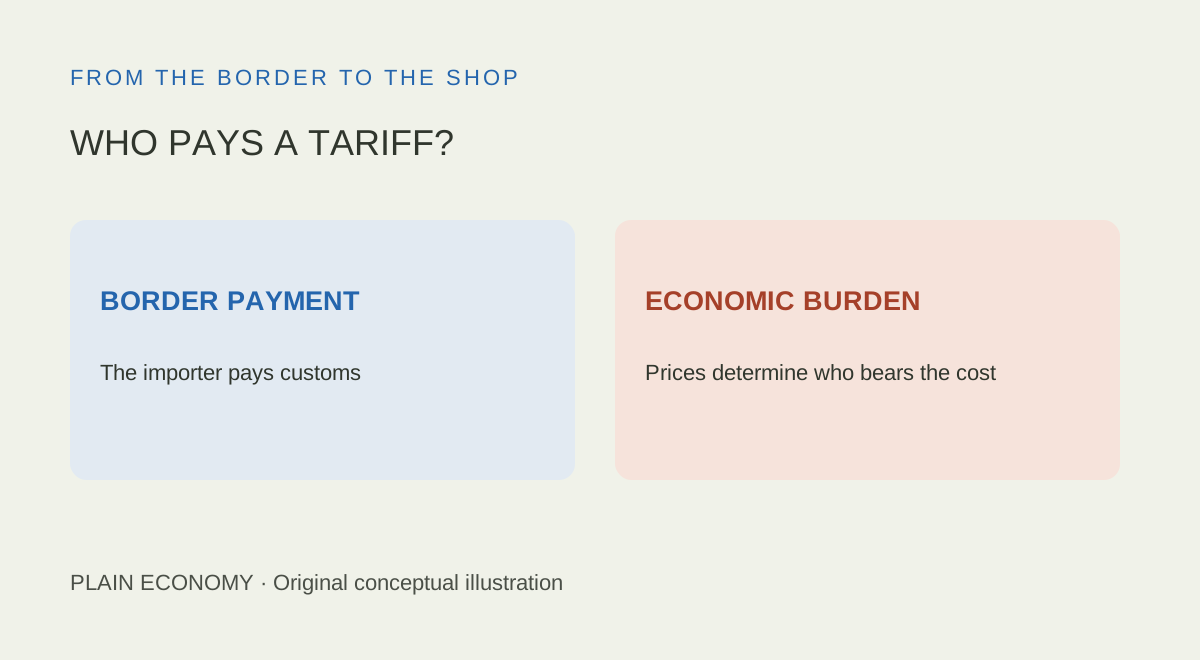
Who writes the cheque? Who bears the cost?
$100invented customs value
$20invented duty at 20%
20%hypothetical duty rate
$100assumed customs value
$20initial customs payment
13.3%retail rise from $150 to $170
The importer pays the government in our US example, but that does not establish who ultimately bears the cost. A foreign supplier can accept a lower price, an importing retailer can keep less of each sale, and a customer can pay more. These adjustments can happen together. The tariff percentage alone cannot tell us their proportions. Following one unchanged product from its supplier to the shop makes the difference between a customs payment and an economic burden easier to see.
The importer pays customs, using a defined tax base
The official 2025 edition of US customs regulation 19 CFR 141.1 describes duties as a debt owed by the importer to the United States. A broker can transmit payment, but paying the broker does not discharge that liability if customs is not paid. This institutional example does not mean the importing company must be American-owned. Ownership and the legal responsibility to pay are separate questions.
A tariff can be a percentage of customs value, sometimes called an ad valorem duty. Other duties use measures such as quantity. For our arithmetic, a genuine supplier invoice of $100 is also the assumed customs value, and the invented rate is 20%. Customs receives $20. The importer pays the supplier $100 and customs $20, making its duty-inclusive acquisition cost $120. That amount excludes transport, insurance, fees and all other costs.
A 20% tariff adds $20 to a $100 customs value
Separate amounts, not three costs to add together. Hypothetical dollars, zero baseline.
See the data
| Payment | Dollars |
|---|---|
| To supplier | 100 |
| To customs | 20 |
| Total, not additional | 120 |
Actual liability depends on the product's classification, origin, valuation rules and applicable law, including exemptions. These differ across jurisdictions. Our simplified US example is not a declaration method or a guide to any current rate. In particular, a business cannot simply declare a convenient lower value. A real negotiated change in the supplier price is different from undervaluation.
Prices and margins determine who absorbs the burden
Suppose one business both imports and retails the product. Before the tariff it buys for $100 and sells for $150. Its $50 difference is a gross surplus before operating costs, not net profit. Wages, rent and other expenses still have to be paid. Holding quantity, currency and every omitted cost fixed lets us isolate the price adjustments.
If the supplier keeps charging $100 and the retailer raises its price to $170, the customer pays the entire $20 dollar increase. The retailer retains the same $50 gross surplus. If competition prevents any retail increase, the shop price stays $150 and the gross surplus falls to $30. Neither outcome follows automatically from the legislation: each is a conditional example.
The same tariff rate can produce different shop prices
One importing retailer, fixed quantity. Bars show selling price; the table separates the supplier, duty and gross surplus. Hypothetical dollars, zero baseline.
See the data
| Scenario | Supplier/customs value | Rate | Duty | Duty-inclusive cost | Retail price | Gross surplus |
|---|---|---|---|---|---|---|
| No tariff | 100 | 0% | 0 | 100 | 150 | 50 |
| Customer pays | 100 | 20% | 20 | 120 | 170 | 50 |
| Retailer absorbs | 100 | 20% | 20 | 120 | 150 | 30 |
| Shared adjustment | 90 | 20% | 18 | 108 | 154 | 46 |
A shared adjustment is more revealing. Let the supplier cut its genuine price to $90. The 20% duty becomes $18, not $20, and duty-inclusive acquisition cost becomes $108. At a retail price of $154, the retailer retains $46. Compared with the original no-tariff case, supplier receipts fall $10, retailer gross surplus falls $4, and the customer pays $4 more. Together, $10 + $4 + $4 equals the $18 customs receipt.
This reconciliation is accounting for one fixed unit, not an estimate of social welfare. It excludes changes in sales volumes, production costs, public services financed by revenue and the allocation of resources. Customs revenue is not automatically an equal net loss to the economy. Likewise, a smaller per-unit surplus does not establish the change in a retailer's total profit.
The supplier price cut reduces duty-inclusive cost by $12 relative to the $120 unchanged-supplier-price case: $10 less to the supplier and $2 less duty. Customers who can switch easily constrain retailers' price increases. Suppliers with attractive alternative buyers have less reason to discount. Contracts, inventory and competitors influence how quickly either side adjusts. Exchange rates can also change the local-currency cost, but their direction is not guaranteed by the existence of a tariff.
The tariff rate and the retail-price rise use different denominators
Even complete transfer of the dollar customs bill to shoppers does not imply the same percentage increase on the shelf. Our $20 duty is 20% of a $100 customs value. Added to a $150 shop price, it raises that price to $170: an increase of roughly 13.3%. Domestic costs and the retailer's existing dollar surplus were already inside the original price.
A 20% duty does not mean a 20% retail price rise
Each product has a $100 customs value and $20 duty. Exactly $20 is added to each starting retail price. Percentage retail increase, zero baseline.
See the data
| Original retail price | Duty | New retail price | Retail rise |
|---|---|---|---|
| 125 | 20 | 145 | 16.0% |
| 150 | 20 | 170 | 13.3% |
| 200 | 20 | 220 | 10.0% |
The comparison assumes unchanged domestic costs and dollar surplus, not an unchanged percentage markup. If a business also changes its markup, its final price follows a different calculation. An unchanged shelf price immediately after a tariff is equally inconclusive: old inventory and contracts can postpone adjustments. Federal Reserve staff research on 2025 household purchases documents gradual retail adjustments. Its product coverage does not represent every item in the household basket.
Border evidence is different from a household's bill
A February 2026 New York Fed analysis of the 2025 US tariffs estimated that nearly 90% of the burden fell domestically at the border. Its data ran through November 2025. The estimated importer incidence was 94% in January–August, 92% in September–October and 86% in November. This concerns the import-cost adjustment borne domestically rather than by exporters. It is not a finding that shoppers paid 90% at checkout, and it is not a universal proportion for future tariffs.
The border study examines prices at the import stage. Retail research asks a later question after distribution, inventories and margins intervene. Subsequent New York Fed research also distinguishes direct consumer-price effects from imported-input costs and domestic markup responses. Locally made goods can therefore be affected through production costs and competition. Those channels prevent us from treating imported finished products as the entire story.
When a headline says a tariff is being paid by a country, first ask which payment it measures: the customs remittance, the supplier price adjustment or the final shop price. Then ask which goods and period were studied. A 20% tariff on one product or input does not mean all consumer prices rise 20%. A rise in selected price levels also differs from a permanently higher annual inflation rate. Those distinctions turn a political slogan into a question that evidence can actually answer.
Optional: reproduce the arithmetic
Duty = tariff rate × customs value. Duty-inclusive acquisition cost = supplier price + duty. In these examples customs value equals supplier price. Retail gross surplus = retail price − supplier price − duty, before operating costs. Retail percentage increase = (new retail price − old retail price) / old retail price × 100. No exchange-rate, quantity or other-cost changes are included.
Sources and method
- U.S. government: 19 CFR 141.1, liability for duties (2025 edition)
- New York Fed: Who Is Paying for the 2025 U.S. Tariffs? (12 February 2026)
- Federal Reserve: The Slow Climb (5 March 2026)
- New York Fed Staff Report 1201: The Anatomy of Tariff Pass-Through into Consumer Prices (revised September 2026)
Checked 16 October 2026. US institutional example; no product-specific legal or customs advice. All chart amounts are invented dollar calculations for one unit. Historical research estimates retain their stated period and scope.
Keep reading.
A cheaper share is not a cheaper companySave €100 more or earn one percentage point more?
House prices fall. Why can buying cost more?
Invest €12,000 now or €1,000 a month?
Investing in Switzerland: francs, stocks and ETF currencies
Volume profile: support, resistance and stop-losses
Fear & Greed Index: opportunity or a warning?
What is the VIX? Calm stocks and rising bond yields
Big Tech is borrowing billions for AI. Why lenders now want more interest