THE IDEA IN ONE LINE
A proportional split changes the number and reference price of shares together. Ownership and company value do not increase through that arithmetic.
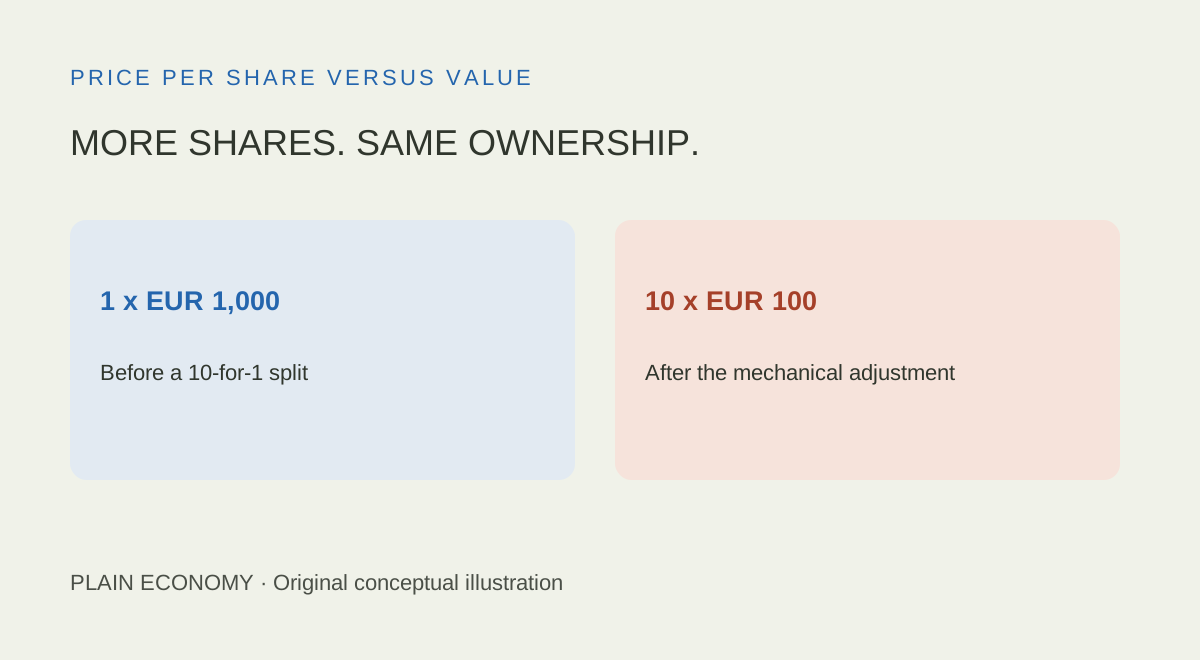
More pieces. The same share of the business.
1 × 1,000euros before
10 × 100euros after
10-for-1hypothetical forward split
0.1%ownership before and after
10×unchanged example P/E
1-for-10separate reverse-split example
A share falling from EUR 1,000 to EUR 100 can leave its owner exactly as wealthy as before if a ten-for-one stock split multiplies the number of shares by ten. The company has divided ownership into smaller units. It has not created new earnings or made the business ten times cheaper. A lower whole-share purchase price can change practical accessibility, but valuation requires more information. The key is to compare both prices and ownership on the same basis.
A split changes the units in which ownership is counted
Investor.gov defines a stock split as an increase in share count without a change in shareholders' equity or proportionate ownership. Imagine an entire company divided into 1,000 shares. You own one, quoted at EUR 1,000, and therefore own 0.1% of the company. A ten-for-one split changes each old share into ten new ones. The company now has 10,000 shares and you hold ten. Your fraction is still 0.1%.
The corresponding mechanical reference price is EUR 100. One multiplied by EUR 1,000 and ten multiplied by EUR 100 both equal EUR 1,000. The company's market capitalisation, meaning its share price multiplied by outstanding shares, remains EUR 1 million in this illustration. We assume a proportional adjustment for every holder, no fractions or other issuance, and no simultaneous market movement.
Ten shares at EUR 100 preserve the original EUR 1,000
Your holding value before and after a hypothetical 10-for-1 split. EUR, zero baseline. Share count and ownership are shown in the table.
See the data
| Stage | Held shares | Price EUR | Holding EUR | Company shares | Ownership | Market cap EUR |
|---|---|---|---|---|---|---|
| Before | 1 | 1,000 | 1,000 | 1,000 | 0.1% | 1,000,000 |
| After | 10 | 100 | 1,000 | 10,000 | 0.1% | 1,000,000 |
FINRA explains that the market determines prices after the split. The mechanical reference is therefore not a guaranteed trade quotation. Investors can change their assessment of earnings, interest rates or risk at the same time. News announced alongside a split can also matter. A price move around the event does not by itself establish that the split caused an economic gain or loss.
A split differs from selling additional shares to raise money. If new shares go to someone else and your holding does not increase proportionally, your ownership fraction can fall. That does not establish that the transaction is harmful: the cash raised and what the company does with it also matter. The allocation of shares and the change in company resources are more informative than the share-count increase alone.
Earnings per share must use the same split basis as the price
A lower share price is not enough to show that a company is inexpensive. In our example, suppose annual company earnings remain EUR 100,000. Dividing those earnings by 1,000 shares gives EUR 100 per share before the split. Dividing the same earnings by 10,000 shares gives EUR 10 afterwards. Nothing has happened to the company's total profit.
The price-to-earnings ratio, or P/E, compares a share's price with earnings per share. Before the split, EUR 1,000 divided by EUR 100 is ten. Afterwards, EUR 100 divided by EUR 10 is also ten. The investor pays the same multiple of earnings. Comparing the new price with the old, unadjusted earnings figure would produce a misleading ratio.
The price-to-earnings ratio does not become cheaper
Unchanged annual earnings of EUR 100,000. Bars show P/E multiples, not euro amounts. Zero baseline.
See the data
| Stage | Company earnings EUR | Company shares | EPS EUR | Price EUR | P/E |
|---|---|---|---|---|---|
| Before | 100,000 | 1,000 | 100 | 1,000 | 10× |
| After | 100,000 | 10,000 | 10 | 100 | 10× |
This is deliberately simplified annual arithmetic using a constant share count on each comparison basis. Actual reported earnings per share use accounting conventions, including weighted average shares and distinctions between basic and diluted earnings. Readers should use consistently adjusted company statements and price data rather than mixing figures from different periods or providers.
Even a correctly calculated P/E is only one lens. Expected growth, debt, cash, the sustainability of earnings and business risk affect what a valuation means. Two unrelated companies quoted at EUR 10 and EUR 100 cannot be ranked by cheapness using their share prices alone. They can divide very different businesses into very different numbers of ownership units.
NVIDIA's historical split illustrates the mechanics, not a return promise
NVIDIA's subsequent financial commentary confirms that it completed a ten-for-one split on 7 June 2024. Its investor FAQ set 10 June for split-adjusted trading and described nine additional shares for each eligible old share. The issuer identified making ownership more accessible as its rationale and stated that proportionate ownership was preserved. Our EUR 1,000 and EUR 100 examples are invented; they are not NVIDIA's historical quotations.
The issuer also separately increased its cash dividend. That is a distinct decision, not an automatic consequence of dividing share units. If a company keeps the total payment to the same holding unchanged, ten times as many shares require one tenth of the old dividend per share. A separate dividend increase can change that cash flow. Combining both announcements into a single claim about the effect of a split would obscure what changed.
Buying one whole share requires less cash after a forward split at the mechanical reference price. Some investors already have another route through fractional shares. The SEC explains that fractional-share availability and processing differ across brokers and securities. Smaller units therefore improve one aspect of access without proving better value, safer ownership or a guaranteed future gain.
A reverse split cannot repair the business through arithmetic
A reverse split combines existing units. In a separate hypothetical company, ten shares at EUR 10 become one share at a EUR 100 mechanical reference price after a one-for-ten reverse split. Both holdings are worth EUR 100. The tenfold rise in the quoted unit price is not a 900% investment gain.
A reverse split raises the unit price without creating value
Your holding value before and after a hypothetical 1-for-10 reverse split. EUR, zero baseline.
See the data
| Stage | Held shares | Price EUR | Holding EUR |
|---|---|---|---|
| Before | 10 | 10 | 100 |
| After | 1 | 100 | 100 |
Investor.gov notes that companies can use reverse splits in connection with exchange price requirements. Combining shares does not by itself create cash, reduce debt or fix weak earnings. It also does not prove fraud or insolvency. The company's reason for the action and its financial condition still need to be examined separately. Subsequent losses remain possible.
Practical processing deserves attention. A holding that does not divide neatly can produce a fraction or a cash payment under the applicable terms. Open orders also need checking: FINRA Rule 5330 has specific US requirements for covered order adjustments and for pending orders on reverse splits. Those rules are not a universal description of every broker worldwide. Read the issuer notice and your broker's instructions rather than assuming a stop or limit order survives unchanged.
Options require their own action-specific treatment. OCC's investor education service directs readers to the relevant corporate-action adjustment information. Deliverables, strikes and contract counts should not be guessed from the stock ratio alone. Tax consequences likewise depend on jurisdiction and circumstances. The useful comparison is what you own, what that holding is worth on a consistent basis, and what changed in the underlying business. A more attractive-looking unit price answers none of those questions by itself.
Optional: reproduce the split calculations
For a forward split ratio k, new held shares = old held shares × k, and the mechanical new price = old price / k. Holding value therefore stays shares × price. In our forward example, 1/1,000 = 10/10,000 = 0.1%. With unchanged earnings and proportional shares, EPS is divided by k and P/E stays unchanged. For a 1-for-10 reverse split, divide shares by ten and multiply the mechanical price by ten. These identities exclude market movements and fractional adjustments.
Sources and method
- SEC Investor.gov: Stock split
- FINRA: Stock splits
- SEC Investor.gov: Price-earnings ratio
- NVIDIA: 2024 stock split investor FAQ
- NVIDIA: Q3 FY2025 CFO commentary, completion and adjusted figures
- SEC Investor.gov: Reverse stock splits
- SEC Investor.gov: Fractional-share investing bulletin (9 November 2020)
- FINRA Rule 5330: Adjustment of orders
- OCC/OIC: Corporate actions and options
Checked 16 October 2026. Original hypothetical euro arithmetic is separate from the documented 2024 NVIDIA event. No current share price, forecast or investment recommendation is supplied.
Keep reading.
Who really pays a tariff?Save €100 more or earn one percentage point more?
House prices fall. Why can buying cost more?
Invest €12,000 now or €1,000 a month?
Investing in Switzerland: francs, stocks and ETF currencies
Volume profile: support, resistance and stop-losses
Fear & Greed Index: opportunity or a warning?
What is the VIX? Calm stocks and rising bond yields
Big Tech is borrowing billions for AI. Why lenders now want more interest