THE IDEA IN ONE LINE
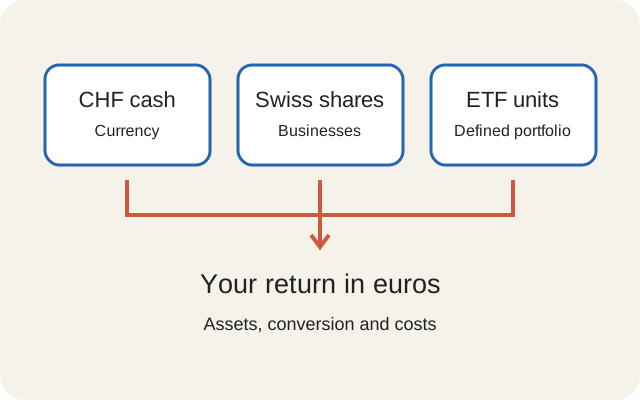
Owning francs, owning Swiss companies and trading an ETF in euros create different exposures.
A strong currency is only one part of the return.
+21%invented euro return with two +10% effects
−1%invented euro return with +10% shares and −10% currency
1,210ending euros in the stronger-franc example
990ending euros in the weaker-franc example
20SMI constituents under its published definition
25%gain needed after an invented 20% loss
Buying Swiss francs, buying Swiss shares and buying an ETF quoted in euros are three different decisions. A franc holding changes value when currencies move. A share also depends on a business. An ETF, or exchange-traded fund, packages a defined investment exposure; its trading currency does not automatically remove exchange-rate risk. For someone measuring wealth in euros, both the investment return and currency conversion matter. Neither Switzerland's reputation nor a rising historical chart tells you what the next return will be.
Start with what you actually own
Imagine three receipts. One records money exchanged into francs. Another records shares in Swiss companies. The third records units in a fund tracking a Swiss stock index. Only the first is simply a currency holding, and even then interest, charges and the account's terms matter. The others introduce business and stock-market risk. Calling all three “investing in Switzerland” hides the differences that determine your result.
The Swiss franc has attracted investors seeking stability during periods of uncertainty. The Swiss National Bank explains this through Switzerland's political and economic stability and low inflation. This describes a historical demand characteristic, not insurance against every crisis. A currency considered a haven can still fall against your spending currency over the period that matters to you.
A Swiss equity index is also a particular selection of securities. SIX defines the SMI as the 20 largest and most liquid SPI equities. Weighting follows free-float market value, based on shares available to investors rather than locked-up holdings, with caps on individual weights; twenty constituents do not mean twenty equal positions. The SPI is broader, covering practically all eligible Swiss and Liechtenstein equities listed on SIX, subject to its rules. Broader does not mean free of concentration or market risk.
Companies listed in Switzerland can earn revenue and pay costs abroad. Their exposure is therefore more complicated than the currency of their share price. A fund's country label does not give you a slice of everything produced in Switzerland, nor does it turn shares into franc cash. Look at the actual index, holdings and weights before treating a national label as diversification.
A euro quotation does not cancel currency exposure
Suppose an unhedged fund gives you Swiss equity exposure and your broker lets you buy its units in euros. The euro is the currency used for that transaction. It does not, by itself, change the underlying investment. Deutsche Börse distinguishes the investor's home currency, the securities' currencies, the fund's reporting currency and its trading currency. These labels answer different questions.
The same ISIN can trade in multiple currencies on Xetra. An ISIN is an international security identifier: it helps you check whether two listings represent the same fund unit. Buying one quotation rather than another can change dealing and conversion arrangements without changing the fund unit you own. An explicit “EUR hedged” designation describes a different feature: a policy intended to offset specified currency exposure. Verify it in the share-class documents rather than inferring it from the euro price on a screen.
The same shares, three different euro outcomes
Hypothetical EUR 1,000 investment; shares return +10% in CHF in every case. No fees or taxes.
See the data
| Currency scenario | Share return in CHF | CHF value in EUR | Ending EUR | Euro return |
|---|---|---|---|---|
| CHF +10% | +10% | +10% | 1,210 | +21% |
| CHF unchanged | +10% | 0% | 1,100 | +10% |
| CHF −10% | +10% | −10% | 990 | −1% |
In the first invented case, EUR 1,000 buys a Swiss equity holding. Its value rises 10% in francs, while each franc becomes worth 10% more euros. The ending value is EUR 1,210: a 21% return. If the same shares gain 10% but each franc becomes worth 10% fewer euros, the ending value is EUR 990: a 1% loss. The effects multiply rather than add. These scenarios omit costs, taxes and interim cash flows.
Always name the direction of an exchange rate. Here, “franc up 10%” means a 10% rise in the euro value of one franc. A screen showing CHF per euro uses the opposite quotation. Its percentage change is not simply the same number with the sign reversed, because taking a reciprocal changes the arithmetic.
The return calculation
Let q be euros per franc. Ending euro wealth = starting euro wealth × (1 + return in CHF) × (ending q / starting q). In our examples: 1,000 × 1.10 × 1.10 = 1,210; 1,000 × 1.10 × 0.90 = 990. “Return in CHF” here includes the assumed investment's total return; an actual calculation must handle cash flows consistently.
A stronger franc can help your conversion and hurt a business
The same appreciation that raises the euro value of a franc holding can make life harder for a Swiss exporter. A company receiving euros gets fewer francs when it converts them; its Swiss costs do not automatically fall with those receipts. Conversely, imported goods can become cheaper in francs. The SNB describes both effects, including how appreciation helped contain imported inflation in 2021–2023.
A stronger franc can squeeze foreign sales
Invented exporter receives EUR 100. Its fixed CHF 80 cost is an assumption, not a company forecast.
See the data
| Rate in CHF per EUR | EUR receipts | CHF receipts | Assumed CHF costs | CHF surplus |
|---|---|---|---|---|
| 1.00 | 100 | 100 | 80 | 20 |
| 0.90 | 100 | 90 | 80 | 10 |
Our invented business receives EUR 100. At CHF 1 per euro, that is CHF 100. At CHF 0.90 per euro, it is CHF 90. Holding an assumed CHF 80 cost unchanged halves the illustrative surplus from CHF 20 to CHF 10. Real companies can change prices, source inputs abroad, hedge receipts or face different demand. This is a mechanism, not an earnings forecast; it does not establish the direction of their shares.
The central bank's objective also changes the story. Buying foreign currencies with francs puts downward pressure on the franc; buying francs with foreign currency puts upward pressure on it. The SNB’s 2024 account describes foreign-currency purchases against deflation risk in 2009–2021, then foreign-currency sales after the pandemic inflation surge. “The SNB always wants a weaker franc” is an unreliable shortcut.
Policy commitments are not permanent price guarantees. On 15 January 2015, the SNB discontinued its minimum exchange rate of CHF 1.20 per euro. This had been a floor under euros measured in francs, effectively limiting franc strength against the euro. The SNB later explained that defending it required interventions of rapidly increasing magnitude. That episode warns against treating a past policy rule, or a channel drawn on a chart, as a permanent boundary.
Hedging changes one risk rather than removing investment risk
A currency-hedged share class seeks to reduce a defined exchange-rate component. It cannot protect you from every fall in the shares. Nor does it erase the effect of currencies on companies' revenue, input costs or competitiveness. The hedge's reference currency, target exposure and adjustment rules need checking in the actual documents.
UBS describes ETF currency hedges implemented with foreign-exchange forwards that are periodically reset. Interest-rate differences, transaction and renewal costs, changes in portfolio value and adjustment timing affect results. The economic effect is not a universal fixed fee, and it need not always reduce the return. A hedge can remain imperfect between adjustments; the total expense ratio alone does not capture every difference between hedged and unhedged results.
Replication is a separate question. Invesco explains that physical replication holds securities, while synthetic replication can use a swap to obtain an index return. “Synthetic” does not mean “currency hedged”; “physical” does not mean “unhedged”. The index and share-class terms define what return is sought, while the structure introduces its own operational and counterparty considerations.
There is another possible link between currencies and market stress. A carry trade borrows in one currency to buy an asset in another. As the BIS explains, leverage and currency moves can make such positions vulnerable. Closing a franc-funded trade can require selling the asset and buying francs to repay the debt. That can support the franc while risky assets are sold, but it is one possible channel, not proof of the cause of every sell-off. An ordinary unleveraged Swiss equity ETF purchase is not itself this borrowing strategy.
Compare the return and the difficult journey separately
Before comparing two charts, align the dates, reference currency and dividend treatment. SIX distinguishes a price index, which omits dividends, from total-return and net-return versions, which reinvest dividends on different tax assumptions. A franc-denominated price chart is not the same as the euro wealth experience of an investor receiving distributions, paying fees and incurring taxes.
A 20% loss needs a 25% gain to recover
Hypothetical wealth units. Bar lengths show levels, not elapsed time or probabilities.
See the data
| Stage | Wealth units | Change from previous stage |
|---|---|---|
| Previous peak | 100 | — |
| After loss | 80 | −20% |
| Recovered | 100 | +25% |
A profitable endpoint can conceal a painful path. Drawdown measures a decline from a previous peak; the maximum drawdown is the deepest such decline in the chosen series and period. In our example, wealth falling from 100 to 80 loses 20%. Returning from 80 to 100 requires 25%, because the recovery starts from a smaller base. A positive eventual return does not tell you how long recovery took or whether you could have held through the loss.
The useful question is therefore specific: which assets do I own, in what proportions, how does their value translate into my spending currency, and what does the share class hedge? Read the index method, fund documents, distribution policy, costs and currency rules together. A view that the franc will strengthen is a currency thesis. An expectation that Swiss businesses will prosper is an equity thesis. Keeping those claims separate makes each easier to examine without pretending either can guarantee the outcome.
Sources and method
- SNB: What determines the Swiss franc exchange rate?
- SNB: How does the SNB keep inflation on track?
- SNB: Interest rates and foreign exchange interventions (9 April 2024)
- SNB: Discontinuation of minimum exchange rate (15 January 2015)
- SNB: Monetary policy after discontinuation (24 April 2015)
- Deutsche Börse: ETF currency exposure and hedging
- Deutsche Börse: ETF products and trading currencies
- UBS: Understanding ETF currency hedging
- Invesco: physical and synthetic ETF replication
- SIX: Swiss Market Index (SMI)
- SIX: Swiss Performance Index (SPI)
- SIX: price, total-return and net-return indices
- BIS: Carry off, carry on (September 2024)
Sources checked 15 October 2026. All numerical charts are original hypothetical examples; no live prices, historical performance series, current portfolio weights or forecasts are supplied. The currency arithmetic is calculated independently rather than copied from approximate worked examples. Inspired by José Luis Cava's discussion of Switzerland, the franc and investing; the video is a starting question, not evidence for a product recommendation.