THE IDEA IN ONE LINE
The property price, cash needed upfront and ongoing ownership budget are separate constraints.
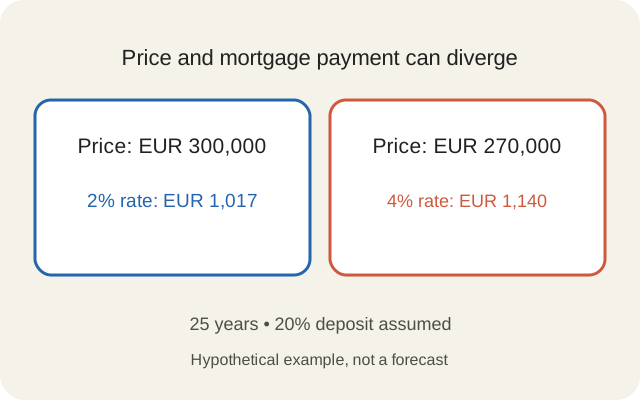
A cheaper house can come with a larger payment.
−10%hypothetical purchase-price change
+12.08%payment change if the assumed rate rises from 2% to 4%
25years in the main hypothetical loan
20%assumed deposit, not a required minimum
1,017.25monthly euros at EUR 300,000 and 2%
1,140.13monthly euros at EUR 270,000 and 4%
A house can fall in price while becoming harder to afford with a mortgage. The property price determines how much you pay the seller; the interest rate helps determine what financing that purchase costs each month. A smaller loan at a higher rate can require a bigger payment. A lower deposit can help with the cash needed upfront without solving the monthly budget. This is a conditional explanation, not a claim that prices are currently falling everywhere or that buying now is better than waiting.
Price and financing can move in opposite directions
Consider an invented EUR 300,000 home. With a 20% deposit, the buyer puts down EUR 60,000 and borrows EUR 240,000. A fully repaid, 25-year mortgage at a 2% annual nominal rate requires approximately EUR 1,017.25 a month in principal and interest. Suppose the same kind of property becomes 10% cheaper, at EUR 270,000, while the available rate rises to 4%. The deposit falls to EUR 54,000 and borrowing to EUR 216,000, yet the payment rises to EUR 1,140.13.
That is about EUR 122.88 more each month, a 12.08% increase, despite the lower purchase price. At an assumed 6% rate on the cheaper property, the payment becomes EUR 1,391.69, approximately 36.81% above the original case. These are controlled calculations, not bank quotations. We hold the term and deposit percentage constant to show how the price and interest-rate effects interact.
A lower price can be outweighed by a higher mortgage rate
Hypothetical monthly principal plus interest in EUR. Every case assumes a 20% deposit and a 25-year loan.
See the data
| Price EUR | Deposit EUR | Loan EUR | Annual rate | Monthly P&I EUR | Total interest EUR |
|---|---|---|---|---|---|
| 300,000 | 60,000 | 240,000 | 2% | 1,017.25 | 65,175.12 |
| 300,000 | 60,000 | 240,000 | 4% | 1,266.81 | 140,042.53 |
| 300,000 | 60,000 | 240,000 | 6% | 1,546.32 | 223,897.01 |
| 270,000 | 54,000 | 216,000 | 2% | 915.53 | 58,657.61 |
| 270,000 | 54,000 | 216,000 | 4% | 1,140.13 | 126,038.27 |
| 270,000 | 54,000 | 216,000 | 6% | 1,391.69 | 201,507.31 |
| 240,000 | 48,000 | 192,000 | 2% | 813.80 | 52,140.10 |
| 240,000 | 48,000 | 192,000 | 4% | 1,013.45 | 112,034.02 |
| 240,000 | 48,000 | 192,000 | 6% | 1,237.06 | 179,117.61 |
The mechanism has a historical counterpart. ECB economists described euro-area affordability deteriorating in 2022–23, despite rising incomes and slightly declining house prices, because mortgage rates rose more. Their July 2025 analysis used an illustrative affordability measure combining income, prices and mortgage rates. That is dated evidence about a particular period, rather than an October 2026 assessment of your neighbourhood.
Our examples assume a rate fixed for the whole loan, equal monthly payments in arrears and an annual nominal rate divided by twelve. Actual contracts differ in rate conventions, initial fixed periods, fees and payment calculations. The 20% deposit is an assumption, not a universal minimum. A genuine offer must be read using its own terms and the rules of its jurisdiction.
The deposit and monthly budget are separate hurdles
The lower-price home needs EUR 6,000 less deposit in our example. That helps a buyer accumulating savings, but the deposit is not all the cash required at completion. The CFPB separates upfront mortgage costs from recurring payments. Its regulatory details concern the United States; the general budgeting distinction travels, while US-specific insurance or escrow rules should not be copied into a European purchase.
Transaction taxes, legal or registration charges, lender fees and moving expenses can require additional cash, depending on the location and transaction. Money remaining after completion also matters when an urgent repair or interruption of income occurs. A buyer who can just assemble the deposit has answered one question about affordability, not every question about sustaining ownership.
A 10% price cut can accompany a 12% payment increase
Hypothetical comparison; each metric is indexed to 100 for EUR 300,000 at 2%. Deposit remains 20% of price.
See the data
| Scenario | Price EUR | Deposit EUR | Monthly P&I EUR | P&I / assumed EUR 3,500 income |
|---|---|---|---|---|
| 300,000 / 2% | 300,000 | 60,000 | 1,017.25 | 29.06% |
| 270,000 / 4% | 270,000 | 54,000 | 1,140.13 | 32.58% |
| 270,000 / 6% | 270,000 | 54,000 | 1,391.69 | 39.76% |
Now assume the household's net income stays at EUR 3,500 a month. Principal and interest alone take 29.06% in the original case, 32.58% for the cheaper home at 4%, and 39.76% at 6%. Those percentages describe our example. They are neither lender approval rules nor universal safety thresholds. Other debts, household spending and the stability of income can make identical payment ratios mean different things.
Principal and interest are not the full monthly ownership budget. Property taxes, insurance and applicable common charges can add to it; maintenance and repairs also need funding. Which items a lender collects within the payment varies. Comparing a mortgage's principal-and-interest figure directly with an all-inclusive rent figure would omit relevant costs on the ownership side.
A lower monthly payment can hide a longer commitment
Principal is the part of the payment that reduces what you owe; interest pays for borrowing. The CFPB explains the changing split during amortization: even with a level combined payment, early payments typically contain more interest and later ones more principal. Principal repayment uses cash while increasing the owner's equity, assuming other values unchanged. It is not all an economic expense, and a falling property value can still reduce that equity.
One way to reduce the monthly figure is to extend the loan. For the same EUR 240,000 principal at 4%, our 20-year example costs EUR 1,454.35 monthly. A 30-year term lowers that to EUR 1,145.80. The smaller payment does not mean the lender has forgiven part of the borrowing: repayment is spread over more months and the outstanding balance attracts interest for longer.
A longer loan lowers the payment and adds interest
Hypothetical EUR 240,000 principal at a 4% annual nominal rate, fixed throughout. Monthly P&I shown in EUR.
See the data
| Term years | Monthly P&I EUR | Total nominal interest EUR |
|---|---|---|
| 20 | 1,454.35 | 109,044.67 |
| 25 | 1,266.81 | 140,042.53 |
| 30 | 1,145.80 | 172,486.82 |
Total contractual interest in those invented loans rises from EUR 109,044.67 over twenty years to EUR 172,486.82 over thirty. This is undiscounted nominal interest, not the whole cost of the home or an investment-return comparison across different horizons. It omits fees, taxes, maintenance and the alternative uses of money. The table makes the trade-off visible without declaring the longer or shorter loan right for every buyer.
How the mortgage examples are calculated
For price P, loan L = 0.8 × P, monthly rate r = annual nominal rate / 12, and n = years × 12. Monthly principal plus interest M = L × r / [1 − (1 + r) raised to −n]. At a zero rate, M = L / n. Total nominal interest = M × n − L. Calculations use unrounded payments; tables round to cents and bars to whole euros. Lender rounding and day-count conventions can differ.
Existing borrowers do not all face the new buyer's rate
A quoted rate for a new mortgage does not immediately reset every existing loan. The ECB explains that mortgage structures affect how policy rates reach households. Variable rates, rates fixed for an initial period and rates fixed for the full term transmit changes differently. A protected existing payment and a new buyer's financing cost can therefore tell different stories about the same housing market.
Nor is “buy now and refinance later” a guaranteed escape. The CFPB notes that changes in property values or personal finances can obstruct refinancing. A future offer, qualification and transaction costs remain uncertain. Cash buyers avoid this mortgage-interest channel, but still face the property's purchase price, ownership expenses and the risk of a lower resale value.
A falling-price headline needs a location and a definition
A national average does not price a particular home. Check the country, city, neighbourhood, property type and comparison period. A month-on-month fall can coexist with a year-on-year rise. The ONS distinguishes asking prices, mortgage-approval measures and completed transactions; they record different stages, and completed-sale statistics can arrive after conditions have changed.
Eurostat's house-price index measures household purchases of new and existing dwellings, while associated transaction costs are excluded from the sales-value measure. A movement in that index is therefore not a complete measure of the cash needed to buy. The inflation adjustment matters too: an unchanged nominal EUR 300,000 price alongside a 10% rise in a general price index implies about a 9.09% real decline. The seller still asks for EUR 300,000, and the buyer's wages need not have risen with inflation.
A useful comparison sheet connects the actual price, deposit and completion cash to the loan, quoted rate, fixed period, full ownership budget and household income. It also asks how payments and reserves behave under a plausible financial setback. That is more informative than reading a falling-price headline as an automatic improvement in affordability. The headline describes a market measure; the household must finance a specific transaction.
Sources and method
- ECB: The ripple effects of monetary policy on housing and consumption (31 July 2025)
- CFPB: How paying down a mortgage works
- CFPB: Mortgage costs
- CFPB: Principal and interest versus total monthly payment
- ECB: Monetary policy transmission (28 May 2025)
- CFPB: Fixed-rate and adjustable-rate mortgages
- ONS: Measuring the UK housing market (16 September 2020)
- Eurostat: House price and sales index metadata
Sources checked 16 October 2026. All numerical examples are original hypothetical calculations in euros. No current market-rate quotation, geographic price forecast, local lending threshold or individual buying recommendation is supplied.
Keep reading.
Invest €12,000 now or €1,000 a month?Investing in Switzerland: francs, stocks and ETF currencies
Volume profile: support, resistance and stop-losses
Fear & Greed Index: opportunity or a warning?
What is the VIX? Calm stocks and rising bond yields
Big Tech is borrowing billions for AI. Why lenders now want more interest