THE IDEA IN ONE LINE
A derivative loss, a portfolio loss and a gain smaller than unhedged gold are different outcomes. Evaluate the whole position over a matching period.
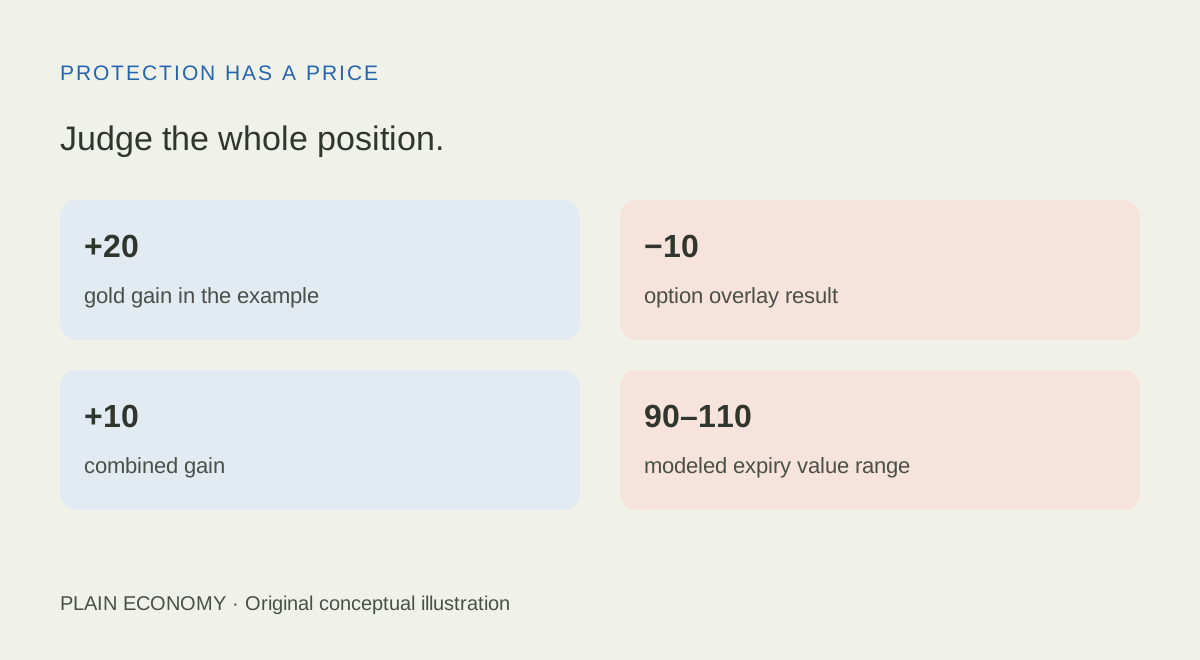
Judge the whole position.
+20gold gain in the example
−10option overlay result
+10combined gain
90–110modeled expiry value range
+20gold gain in the example
−10option overlay result
+10combined gain
90–110modeled expiry value range
If you insure your home and never claim, the insurance payment is not proof that the decision failed. A gold hedge has a similar logic: one component can lose money precisely when the holding it protects becomes more valuable. But that analogy has limits. Some hedges also sell away future gains, protection expires, and a poorly chosen contract can be expensive or unsuitable. The useful question is what the complete position achieved against its original purpose, rather than whether every line on the statement shows a profit.
A hedge changes the outcome you are willing to accept
A put is a right to sell on specified terms. OIC explains that buying a protective put against an owned asset establishes an exit floor during its term, in exchange for a premium. The holder keeps exposure to a rise after that cost. Protection is therefore a service with a price, rather than a separate investment that must always outperform the asset.
A sold call works differently. A covered call receives a premium but gives up participation above its strike; substantial downside remains. Combining an owned asset, a purchased put and a sold call creates a collar. The put establishes the lower bound and the call establishes the upper bound over the stated term. Premium received helps fund protection. It need not exactly cover its cost.
Consider one invented unit of gold initially worth 100 currency units. Buy a matching put with strike 90 for 3, and sell a matching call with strike 110 for 3. Both expire together. We deliberately assume equal premiums; their equality is not a quote or a consequence of the strikes being equally distant. The gold and options refer to exactly the same quantity and price.
A losing option is different from a losing portfolio
If gold finishes at 120, the metal gains 20. The put expires without an exercise payment, so its result is minus its premium of 3. The sold call owes an exercise-equivalent payment of 10, partly offset by the 3 received, for a loss of 7. Together the options lose 10. Gold plus those options still gains 10.
The hedge loses ten; the whole position gains ten
Hypothetical result at a common expiry when gold finishes at 120. Currency units; signed zero baseline.
See the data
| Component | P&L in currency units |
|---|---|
| Gold value change | 20 |
| Bought put, including premium | -3 |
| Sold call, including premium | -7 |
| Both options together | -10 |
| Gold plus collar | 10 |
The unhedged alternative would have gained 20. The collar therefore underperforms that benchmark by 10, while making an absolute gain of 10. Calling all three quantities a loss would confuse a derivative result, a combined result and forgone upside. The distinction also prevents double-counting: the options total is already made from the put and call, and the combined total already includes gold.
Now consider a fall to 80. Gold loses 20, but the put pays 10 before its premium; the sold call expires without an exercise liability. The overlay gains 10 after the offsetting premiums, leaving a combined loss of 10. Protection reduced the loss; it did not preserve all 100 initially committed. The put strike was 90, not 100.
A floor below does not preserve every unit invested
Hypothetical collar ending value at selected expiry prices. Currency units, zero baseline.
See the data
| Gold price at expiry | Gold alone ending value | Collar ending value | Collar P&L |
|---|---|---|---|
| 60 | 60 | 90 | -10 |
| 80 | 80 | 90 | -10 |
| 90 | 90 | 90 | -10 |
| 100 | 100 | 100 | 0 |
| 110 | 110 | 110 | 10 |
| 120 | 120 | 110 | 10 |
| 140 | 140 | 110 | 10 |
Zero net premium does not mean free protection
The collar's modeled terminal value stays between 90 and 110. Its initial net outlay is 100 because the two assumed premiums cancel. Above 110, additional gold gains belong to the call counterparty through the contract. That contingent upside sacrifice is economically meaningful even though no net option premium left the account initially.
Buying only the put costs 103 including the gold and preserves gains beyond the premium. At a terminal price of 120, its profit is 17, and its maximum modeled loss is 13. Gold with only the sold call costs a net 97, but can still lose that entire amount if gold falls to zero. It offers a small premium cushion, not the collar's floor.
Buying a floor and selling a ceiling change the trade-off
Initial net acquisition outlay, hypothetical currency units. Zero baseline; terminal risks are in the table.
See the data
| Position | Initial outlay | Minimum expiry value | Maximum modeled loss | P&L at gold 120 |
|---|---|---|---|---|
| Gold alone | 100 | 0 | 100 | 20 |
| Gold + bought put | 103 | 90 | 13 | 17 |
| Gold + sold call | 97 | 0 | 97 | 13 |
| Gold + collar | 100 | 90 | 10 | 10 |
Different outlays mean that percentage returns need different denominators. Comparing 17 units earned on 103 with 20 earned on 100 requires saying so. The table shows money outcomes to keep that issue visible. Its worst cases are consequences of the assumed payoff rules, not estimates of the probability of a collapse.
Expiry arithmetic is not a live valuation model
These charts value all legs at one common expiry, assuming cash-equivalent settlement. Before then, an option can have value beyond its immediate exercise payoff. OIC identifies time to expiry, implied volatility, the underlying price, strike and interest rates among premium influences. A current marked liability is not automatically a cash loss already paid. Contract terms can nevertheless create collateral or other cash demands before expiry.
Real gold contracts also need careful matching. CME’s educational gold example explains basis differences between futures and physical prices and the importance of the relevant futures contract. A futures option is not automatically a promise to sell a physical bar at the displayed strike. Quantity, currency, maturity, settlement and counterparty terms govern what is protected. Selling the underlying while leaving a sold call open can also remove its cover.
Our model excludes fees, bid–ask spreads, financing, storage, insurance, taxes, currency changes, early exercise, margin constraints and settlement or counterparty failure. Its neat terminal bounds depend on those exclusions and perfect matching. Renewing protection after expiry requires a new transaction at prices not known today.
Judge the mandate before judging the headline
The BIS describes reserve management as a balance among safety, liquidity and return, rather than a contest decided by short-term gains alone. For why institutions hold the metal, see our separate reserve-gold explanation. A household investor and a central bank do not necessarily share the same liabilities or objective.
To assess an actual hedge, identify what was insured, for how long, against which loss, at what full cost and with what cash requirements. Compare matching dates and the complete holding with a suitable benchmark. A rally does not prove that protection was wasteful, and the word hedge does not prove good execution. No country's actual trade or management quality can be inferred from the invented contracts here.
Optional: reproduce the common-expiry calculations
For gold price S ≥ 0, put P&L = max(90 − S, 0) − 3. Sold-call P&L = 3 − max(S − 110, 0). Add S − 100 for the gold result. Collar ending value is min(max(S, 90), 110); subtract the initial 100 for its P&L. With a general net premium debit d, initial outlay is 100 + d, and terminal P&L ranges from −10 − d to 10 − d before other costs.
Sources and method
- OIC: protective put
- OIC: covered call
- OIC: protective collar
- OIC: options pricing
- CME: gold hedging case study
- BIS: balancing reserve management objectives (2024)
Sources checked 17 October 2026. Original hypothetical expiry arithmetic in arbitrary currency units, not actual gold quotes or any country’s transactions. No trading recommendation.
Keep reading.
How to compare wages and investment returns fairlyWhy do central banks buy gold?
Is China selling US debt or changing its custodian?
Buying at market highs: how much does time matter?
Is university worth it? What salary averages hide
A cheaper share is not a cheaper company
Who really pays a tariff?
Save €100 more or earn one percentage point more?
House prices fall. Why can buying cost more?
Invest €12,000 now or €1,000 a month?
Investing in Switzerland: francs, stocks and ETF currencies
Volume profile: support, resistance and stop-losses
Fear & Greed Index: opportunity or a warning?
What is the VIX? Calm stocks and rising bond yields
Big Tech is borrowing billions for AI. Why lenders now want more interest