THE IDEA IN ONE LINE
A useful technology can still be an expensive investment. Follow the customer's payment, the infrastructure bill and the expectations built into the share price.

The machine can work. The price can still be wrong.
+20%hypothetical earnings per share
−25%hypothetical share price
+20%hypothetical earnings growth
−25%hypothetical price return
47.4% → 63.4%Microsoft cash PPE / operating cash
Company-widecash figures are not AI-only returns
Check the evidence
Article sources checked:
This is the check date recorded in the article, not a new independent verification or the publication date of every source.
Measured or reported evidence
- Microsoft's unaudited release reports company-wide operating cash of $136.162bn and $182.935bn, and cash property/equipment additions of $64.551bn and $115.948bn, for fiscal years ending 30 June 2025 and 2026. Our calculated spending-to-cash ratios are 47.4% and 63.4%; these are not AI-only returns.
Invented teaching example
- The €200-to-€150 share-price chart is invented: rise from €5 to €6 while the assumed multiple falls from 40 to 25. No company, fair value or is measured.
Our interpretation
- Useful AI can coexist with disappointing investor returns if the purchase price demands more profit than arrives. The examples demonstrate that possibility; they do not establish that every AI company is overpriced.
What this cannot establish
- Company-wide cash additions exclude non-cash finance lease additions and do not isolate AI profit. Amazon's shorter useful-life estimate concerns a subset of equipment, not every chip. No sector-wide investment return or crash probability is calculated.
What would change the assessment?
- Sustained paid renewals and collected cash after operating and replacement costs would strengthen the investment case. Weak renewals, continuing dependence on partner financing or returns below full infrastructure costs would weaken it. Those results must still be compared with the price investors pay.
Primary sources and their dates
- Microsoft: FY2026 Q4 release
Published 29 July 2026; cash-flow comparison covers fiscal years ending 30 June 2025 and 2026; unaudited release.
- Amazon: 2025 Form 10-K
Reporting year: 2025; useful-life estimate changed from January 2025. The article does not record the filing's publication date.
- Bank of England: Financial Policy Committee Record
Published September 2026; financial-stability risk assessment, not a company fair-value estimate.
Imagine a bakery buying a machine that makes better bread in less time. The machine works. Customers like the bread. Does that make any purchase price sensible? Of course not: the bakery still has to earn enough from those customers to cover the machine, electricity, maintenance and financing. Paying too much can turn a useful invention into a poor investment.
That is the question behind the AI debate. We do not have to choose between “AI is useless” and “every AI investment will pay off”. The important gap lies between what a technology can do, what businesses can keep, and what investors have already paid for that future.
Can AI succeed while AI shares fall?
Yes. Buying a share means paying today for a claim on a business's future. If the price already assumes spectacular growth, merely good results can disappoint. The Bank of England's September 2026 financial-stability assessment treats advancing AI capabilities and demanding earnings expectations as compatible observations. It describes a risk of repricing if expectations disappoint, not a finding that every AI business is overvalued.
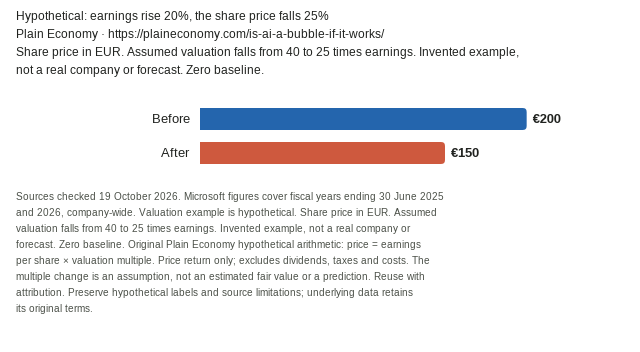
Here is an invented example. A company earns €5 per share. Buyers pay 40 times that amount, so the share costs €200. Later, earnings reach €6: a respectable 20% increase. But buyers now pay only 25 times earnings. The share is worth €150 under those assumptions, a 25% fall. Better business results did not protect the original purchase price.
Hypothetical: earnings rise 20%, the share price falls 25%
Share price in EUR. Assumed valuation falls from 40 to 25 times earnings. Invented example, not a real company or forecast. Zero baseline.
See the data
| Stage | Earnings per share, EUR | Multiple | Share price, EUR |
|---|---|---|---|
| Before | 5 | 40× | 200 |
| After | 6 | 25× | 150 |
Credit Plain Economy and the original sources. Keep the caption and example labels. Reuse conditions
The calculation does not tell us which multiple is right. It shows why “AI will change everything” cannot settle whether a particular share is good value. For the separate question of buying expensive-looking markets, see what historical market highs say about holding periods. A story about the future and a return from today's price are different claims.
Who actually pays for AI?
Follow the money backwards from the final customer. A business pays for software because it expects more sales, less work or another useful result. The software provider pays for computing. The computing provider pays for equipment, buildings and power. The equipment supplier can earn money even while its customer's eventual return remains uncertain. Success at one point in this chain does not establish success everywhere.
There is evidence of paying demand: Microsoft reported more than 30 million paid Microsoft 365 Copilot seats on 29 July 2026. That is more informative than a count of free sign-ups. It does not reveal the average paid price, discounts, renewal behaviour or standalone profit. Multiplying seats by a public list price would invent a revenue figure rather than measure one.
The bakery analogy helps again. Selling many bread machines can be profitable for their manufacturer. Each bakery still needs enough repeat customers to recover its own purchase. For AI, the test is whether customers keep paying enough to support the chain after introductory deals and initial excitement fade.
What does the infrastructure bill tell us?
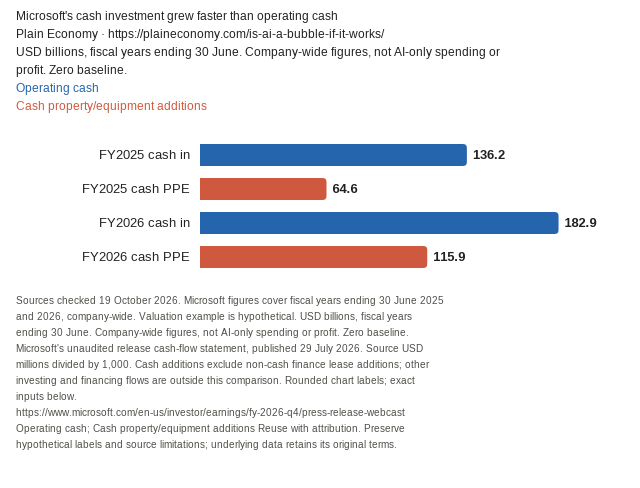
Microsoft provides a useful, bounded comparison. Its unaudited FY2026 release cash-flow table reports operating cash of $136.162 billion for the fiscal year ending 30 June 2025 and $182.935 billion for the year ending 30 June 2026. Cash additions to property and equipment rose from $64.551 billion to $115.948 billion. These are company-wide figures, covering much more than AI.
Microsoft's cash investment grew faster than operating cash
USD billions, fiscal years ending 30 June. Company-wide figures, not AI-only spending or profit. Zero baseline.
- Operating cash
- Cash property/equipment additions
See the data
| Fiscal year | Operating cash | Cash PPE additions | Difference, calculated |
|---|---|---|---|
| FY2025 | 136.162 | 64.551 | 71.611 |
| FY2026 | 182.935 | 115.948 | 66.987 |
Credit Plain Economy and the original sources. Keep the caption and example labels. Reuse conditions
Our calculation divides cash property-and-equipment additions by operating cash: 47.4% in FY2025 and 63.4% in FY2026. Subtracting that investment leaves $71.611 billion and $66.987 billion respectively, before other investing and financing flows. The business generated much more operating cash, yet this particular remainder fell. It stayed strongly positive. Neither fact establishes AI losses or an AI investment return.
This measure also differs from broader capital-expenditure figures that include finance leases. Mixing cash spending with non-cash additions, annual figures with quarters, or realized spending with announced commitments produces a striking total with an unclear meaning. The useful question is how much durable cash the investment eventually creates relative to its full cost.
Why do electricity and equipment replacement matter?
Returning to the bakery, buying the machine does not buy unlimited free bread. Electricity, maintenance and eventual replacement still matter. For computing, the building's useful life and the equipment's competitive life are different questions. A server can still function while newer equipment makes its work less attractive economically.
Amazon's 2025 Form 10-K says it shortened estimated useful lives for a subset of servers and networking equipment from six to five years from January 2025, citing faster technological development, particularly AI and machine learning. That is a specific accounting estimate, not a universal expiry date for chips.
Depreciation spreads an equipment purchase's cost over the years it is expected to help the business. It reduces reported profit without being a fresh cash payment each year. Replacement eventually requires real cash. A convincing return calculation therefore needs both realistic operating costs and equipment economics; revenue growth alone cannot answer it. What Anthropic's adjusted profit leaves out shows a similar issue with stock-based pay, another cost that is not paid in cash.
Does circular financing mean the sales are fake?
No. A supplier can invest in a customer that buys its equipment. Equity financing is not revenue, and an arm's-length sale can be legitimate. OpenAI's financing announcement of 27 February 2026 also describes infrastructure collaboration with NVIDIA. An announcement is evidence of stated arrangements, not proof that every payment has happened or all capacity has been delivered.
The analytical issue is dependence. If customers need continuing partner financing to pay their bills, outside paid demand and cash collection deserve closer attention. The Bank of England flags opacity, leverage and circular arrangements as potential amplifiers of losses. That concern is not an allegation of fraud. For the borrowing mechanism, see why Big Tech borrows to finance AI.
Credit investors face a different question from shareholders: will the borrower repay? Our worked example explains what default protection on Big Tech can and cannot tell us.
What evidence would make the bubble debate useful?
Ask whether paying customers renew, whether the supplier collects cash, what remains after running and replacing infrastructure, and how much earnings growth the purchase price already requires. Then consider a slower-demand case. These questions turn a vague argument about hype into claims that future results can confirm or challenge.
Also check how much of a diversified-looking portfolio depends on the same expectations; see how equal weighting changes exposure to the largest companies. None of this identifies a collapse date or tells a reader to buy or sell. The central possibility is simpler: society can get a useful machine while investors discover they paid too much for its profits.
Sources and scope
- Microsoft: FY2026 Q4 results and unaudited cash-flow statement, 29 July 2026
- Amazon: 2025 Form 10-K, property and equipment accounting note
- Bank of England: Financial Policy Committee Record, September 2026
- OpenAI: financing and infrastructure announcement, 27 February 2026
Checked 19 October 2026. Original cash ratios and hypothetical arithmetic are labelled above. No sector-wide investment total, fair-value estimate or crash probability is claimed. Educational analysis, not personal investment advice.
Question prompted by Euge Oller's video about an AI bubble; independent analysis. A transcript was unavailable, so no claims are attributed to the video.
Keep reading.
Who really pays for AI?Don't use AI? You could still help pay its power bill
S&P 500 versus equal weight: what changes?
All market reports