THE IDEA IN ONE LINE
A customer's payment, an investor's cash and a lender's advance pay for different parts of AI.
From financing to the customer's bill
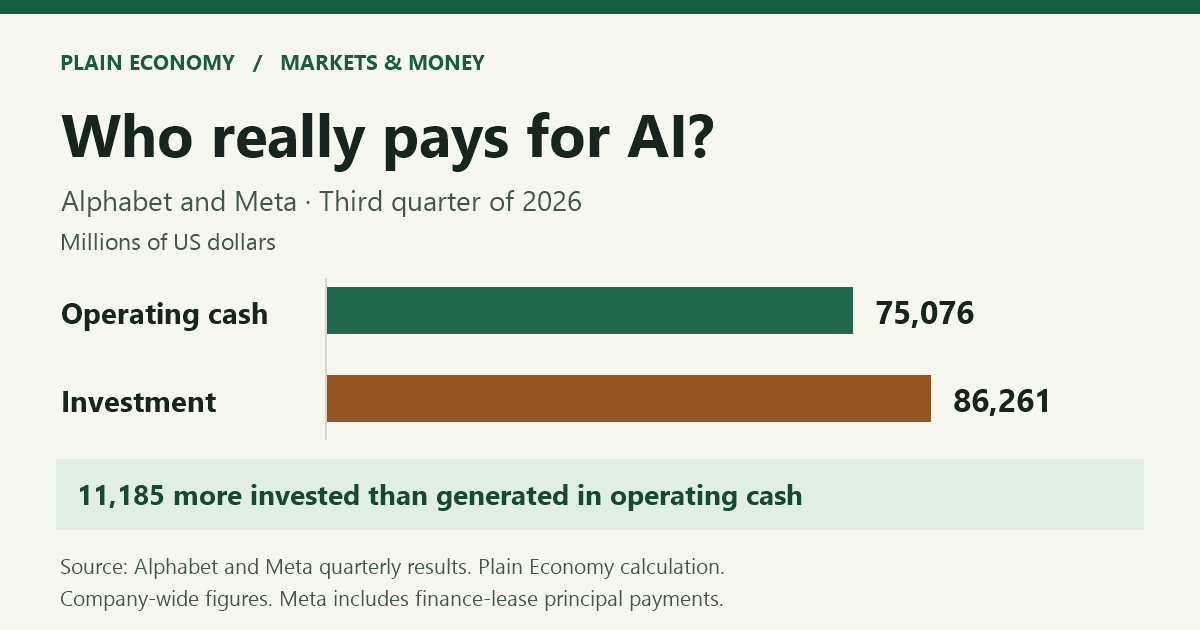
$11,185minvestment above operating cash across both groups
$2,800monthly break-even cost in the hypothetical example
When a customer stops renewing, who bears the loss depends on how the infrastructure was financed.
See the figures and the difference
| Company | Operating cash | Investment | Difference |
|---|---|---|---|
| Alphabet | 42,290 | 51,355 | −9,065 |
| Meta | 32,786 | 34,906 | −2,120 |
| Total | 75,076 | 86,261 | −11,185 |
Who puts up the money for AI?
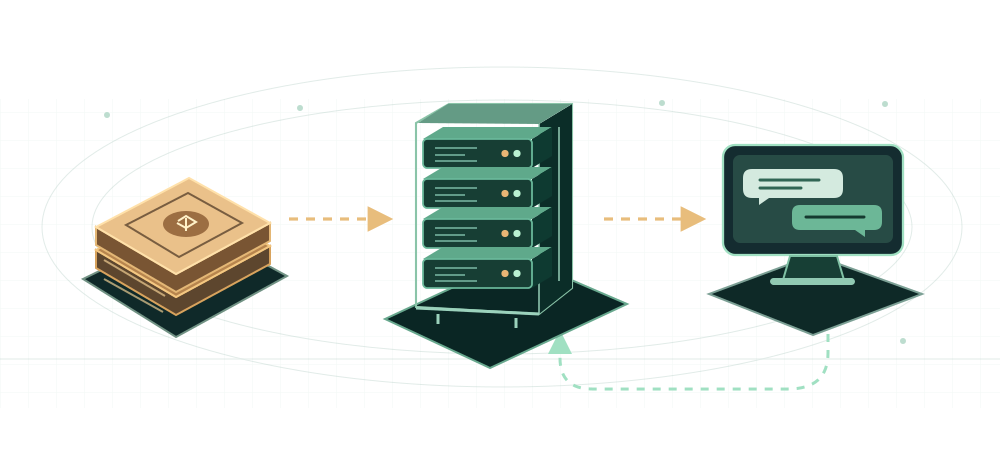
A business that buys access to a model pays the lab. The lab pays for computing power that it owns or rents. The data centre operator pays for equipment and electricity. Each can book revenue from its part of the chain. Adding those sales would count several stages of the same process. To see whether the spending can last, ask how much comes from end customers who pay and renew.
In the meantime, money comes from other sources. Groups with advertising, cloud or subscription businesses can invest some of their cash. Labs can sell shares. OpenAI announced the close of a funding round with $122 billion in committed capital in March 2026. In October, Anthropic filed an S-1 for a proposed IPO. Committed funding, an IPO filing and sales to customers answer different questions. OpenAI's funding round · Anthropic's announcement.
What do the accounts of Alphabet, Meta and SpaceX tell us?
Alphabet generated $42.290 billion in operating cash in the third quarter of 2026 and invested $51.355 billion. Its quarterly free cash flow was negative $9.065 billion, although it remained positive over the trailing twelve months. Google Cloud also reported a $560.8 billion backlog. That represents contracted business still to be recognised, with a timetable that can differ from when cash arrives. Alphabet's quarterly results · Alphabet 10-Q, cloud backlog.
Meta generated $32.786 billion in operating cash and invested $34.906 billion under its definition, which includes payments on finance leases. Its free cash flow was negative $2.120 billion. Meta also recognised a $9.890 billion legal charge in its income statement. The charge, the settlement's payment schedule and infrastructure spending are separate items. Meta's results and reconciliation.
SpaceX shows a different mix. At the end of September, Starlink had 13.6 million consumer subscriptions under the company's definition. In the same quarter, the segment covering AI infrastructure, models and applications reported $431 million in operating profit. Recurring connectivity revenue helps explain why a group can attract funding. SpaceX signed a binding letter with an Apollo-managed entity for a GPU and equipment lease subject to closing conditions. The $40 billion is the expected aggregate principal over the life of the agreement. SpaceX results · SpaceX financing disclosure to the SEC.
Is it a bubble in prices or in debt?
In the first case, share prices build in overly optimistic future profits. If expectations fall, shareholders can lose money even as the company keeps selling services and paying its bills. In the second, the trouble comes from when bills fall due. A data centre may have to repay a loan before it earns enough cash and rely on another lender to refinance it. If borrowing gets more expensive just as rental prices fall, the losses can reach lenders, landlords and suppliers.
A specialised operator, or neocloud, depends more directly on selling computing capacity. CoreWeave is one example. Nvidia agreed to buy eligible spare capacity under an order with an initial value of $6.3 billion. The filing describes the purchase of cloud services. The order can support some revenue within the contract's terms. If the equipment has no buyer, the lender will also care about its value as collateral and the options for recovering its money. CoreWeave's contract disclosure to the SEC.
The video opens with a different distinction. An index can hold up while many stocks fall. In the , the biggest companies carry more weight. Comparing it with the version that resets every company to the same weight helps show how widespread a move is. For credit risk, check , collateral and borrowing costs. S&P Dow Jones Indices methodology.
What if AI works but the customer loses money?
Torsten Sløk, Apollo's chief economist, compared real revenue per worker and profit margins for the seven largest tech names with the rest of the S&P 500. He found little improvement in the latter group's aggregates. This is a descriptive comparison. It mixes businesses with different costs, adoption rates and markets. Measuring the effect of AI would require knowing how those same companies would have done without it. Apollo's original note and charts.
The provider charges $2,000 a month. Its customer saves $2,400 in labour but spends another $800 checking the answers. At the end of the month, the provider bills $2,000 and the customer loses $400 on that workflow. At the same cost, the customer would gain $700 if realised savings rose to $3,500.
The chipmaker sells equipment, the operator sells computing capacity and the lender earns a return for taking risk if the borrower pays. One firm can see weak returns among end users and still join a financing deal whose security it considers attractive. That helps explain why Apollo's note and its account of the SpaceX deal are worth reading together. Incentives shape the questions. The evidence comes from accounts, contracts and cash receipts. Apollo's analysis · Statement on the financing.
See the example calculations
| Scenario | Savings | Cost | Balance |
|---|---|---|---|
| First | 2,400 | 2,800 | −400 |
| Second | 3,500 | 2,800 | +700 |
Which five signs are worth watching?
- Refinancing costs. Compare spreads on similar and, when reliable prices exist, default protection. Prices in thinly traded markets can be noisy.
- Defaults and renegotiations. Distinguish a delayed building project from renegotiated payments or a request for protection from creditors. Look for facts in company disclosures.
- Investment plans. If a big tech company cuts spending, check whether it cites weaker demand, better efficiency, delays or a change in financing terms.
- Customer outcomes. Look for renewals and changes in costs or margins after accounting for model fees, integration and oversight.
- Lab funding. Distinguish fresh capital, sales by existing shareholders and recurring customer revenue. A funding round buys time to operate. Renewals indicate whether the business can pay its own bills.
Sources and scope
This article was prompted by the Desayuno Royale episode. Watch the original episode. Download the figures and assumptions.