THE IDEA IN ONE LINE
Removing a cost from a performance measure does not remove its economic consequences.
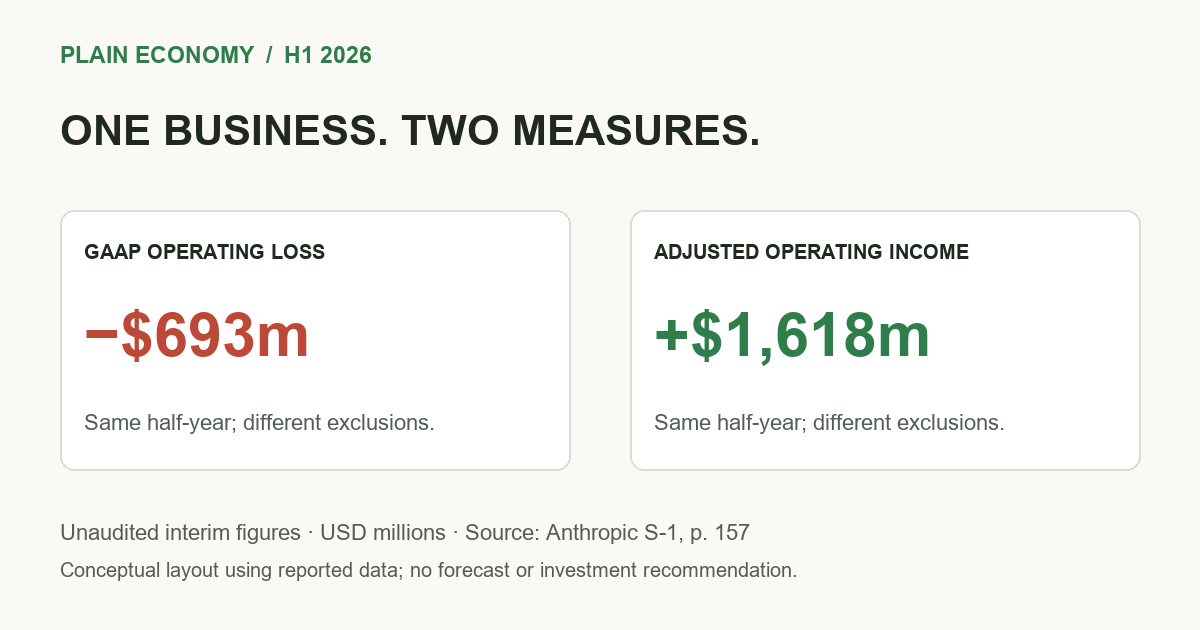
One business. Two measures.
−$693mH1 GAAP operating loss
+$1,618mH1 adjusted operating income
+$974mQ2 GAAP operating income
+$3,929mH1 operating cash flow
A business can look different depending on where its accounts begin and end. For Anthropic, the journey runs from an enormous loss to an adjusted profit. Readers who stop at the destination miss the important part: has the company removed financial noise, or has it also removed costs needed to sell artificial intelligence?
The answer requires separating the two. There are reasons to set aside valuation losses that do not represent immediate cash payments. But paying people partly in shares remains payment for their work. The defensible criticism is that adjusted profit presents a more favorable picture and needs its exclusions explained. These numbers do not establish an intention to deceive.
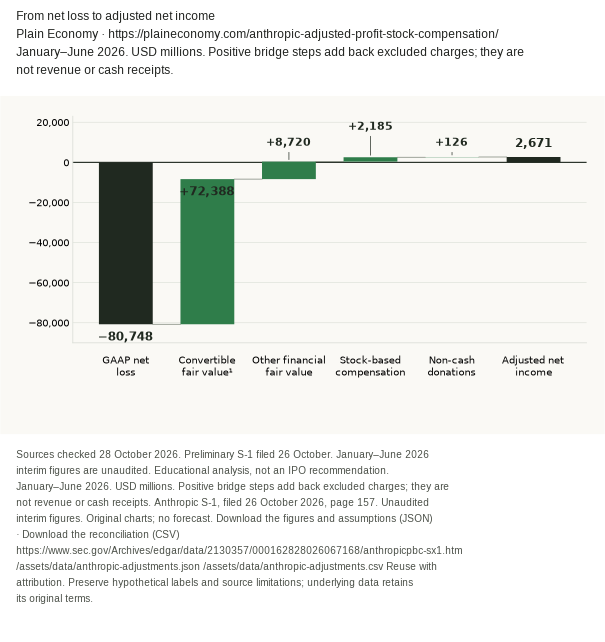
How does Anthropic turn an $80.748 billion loss into a profit?
The SEC filing provides a reconciliation: a bridge between the result under US generally accepted accounting principles, or GAAP, and the adjusted measure selected by the company. These are not two versions of the same result under identical rules. The second answers a different question: what would remain after removing particular charges? S-1, page 157.
All rows: S-1, page 157; unaudited interim information. The Bartz row is retained for completeness; its zero values contribute nothing to either half-year reconciliation.
From net loss to adjusted net income
January–June 2026. USD millions. Positive bridge steps add back excluded charges; they are not revenue or cash receipts.
See the data
| Measure or excluded charge | H1 2025 | H1 2026 |
|---|---|---|
| GAAP net loss | −12,969 | −80,748 |
| Stock-based compensation | 286 | 2,185 |
| Non-cash charitable contributions | 0 | 126 |
| Bartz settlement | 0 | 0 |
| Convertible notes, derivatives and SAFEs: fair-value change | 10,942 | 72,388 |
| Other financial instruments: fair-value change | 0 | 8,720 |
| Adjusted net income (loss) | −1,741 | 2,671 |
Credit Plain Economy and the original sources. Keep the caption and example labels. Reuse conditions
The two financial adjustments total $81.108 billion, or 97.2% of the $83.419 billion added back. Removing only those valuation changes leaves positive income of $360 million. That is our calculation from the table: −80,748 + 72,388 + 8,720. It would therefore be wrong to claim that excluding stock compensation is essential to making this net result positive.
Anthropic attributes the $72.388 billion charge mainly to its increased enterprise valuation and the resulting change in the value of its convertible instruments. In plain English, a financier's contractual rights can become more valuable and create an accounting loss for the financed company. That does not mean Anthropic transferred that amount from its bank account. S-1, page 151.
Why does paying employees in shares still cost something?
Imagine a bakery offering employees cash wages and a stake in the business. Its owner can calculate a friendlier profit by treating that stake as irrelevant to compensation. Yet the business received work in exchange for economic rights. Accounting for share payments recognizes a cost for those services. FASB, educational material on ASC 718.
Consider a hypothetical example. If there are 100 equal shares and the company issues another ten to employees, someone holding one share goes from owning 1% to about 0.91%. That reduction in ownership percentage is dilution. It does not prove the investment has lost value: the entire business can grow more valuable. It does explain why “we did not pay cash” does not mean “we gave up nothing.”
Anthropic excludes $2.185 billion of stock compensation. Keeping all its other adjustments but restoring that cost reduces adjusted net income from $2.671 billion to $486 million. This is a Plain Economy sensitivity calculation, not a company-reported metric or an alternative tax calculation. The hypothetical tax effect of changing each adjustment is not available. Calculation based on the S-1, page 157.
It would also be wrong to turn that $2.185 billion automatically into a dilution percentage or a future cash bill. These measure different things. As with a stock split, which changes the price per share without creating value by itself, ownership rights and total value matter more than the eye-catching number.
Paying in shares does not make the work free
A salary paid in shares is still compensation for work. No immediate cash payment does not mean no expense: excluding it from adjusted earnings changes the metric, not what the employees received. If this remuneration is needed to operate the business, readers should count its economic cost when assessing profitability.
Why can equity stay positive while the company reports a loss?
Equity is a balance-sheet stock; profit is a period result. In a simplified example of vested new shares granted for work already consumed, ignore taxes and other movements: the company recognizes 100 of compensation expense and 100 of contributed equity. The expense lowers profit and, through that result, retained earnings; the capital entry offsets this within total equity. Total equity can therefore remain unchanged by those entries even though the period bears a real expense. Unchanged equity is not proof of free labor.
Positive equity, operating cash flow and adjusted profit answer different questions. None automatically cancels an expense or establishes that the business is profitable after all costs. Conversely, recognizing a share-based expense does not by itself make every business loss-making. Here the relevant reported figures are the H1 operating loss of $693 million and the Q2 operating profit of $974 million, both including the recognized stock-pay expense.
What if the shares pay a supplier rather than an employee?
The means of payment does not remove the cost of what was acquired. However, cost is not always an immediate expense: a purchase that qualifies as an asset may be recognized first as an asset and expensed when consumed, sold or depreciated. Services already consumed are generally expensed as received. Recognition timing and measurement depend on the applicable rules and contract. This is not a claim that every share-funded acquisition must immediately reduce profit.
For a general comparison of goods, services and assets in share-based payment, see IFRS 2, paragraphs 7–9. Anthropic reports under US GAAP; its own expense and reconciliation are documented in the S-1 linked above.
Is the operating business profitable before the adjustments?
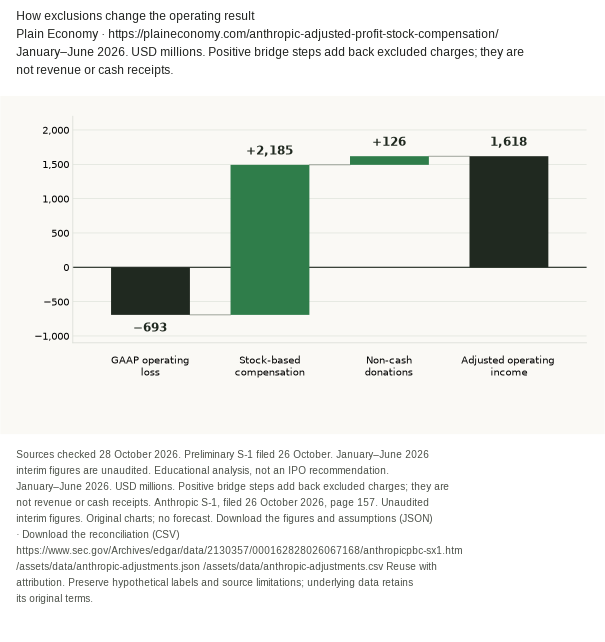
This is where the adjustment changes the profitability story most clearly. Anthropic recorded a $693 million GAAP operating loss for the half-year. Excluding employee stock compensation and $126 million of noncash charitable contributions produces $1.618 billion of adjusted operating income. The operating margin changes from roughly −4% to +10% on $16.286 billion of revenue. S-1, pages 148 and 157.
How exclusions change the operating result
January–June 2026. USD millions. Positive bridge steps add back excluded charges; they are not revenue or cash receipts.
See the data
| Measure or excluded charge | H1 2025 | H1 2026 |
|---|---|---|
| GAAP operating loss | −2,135 | −693 |
| Stock-based compensation | 286 | 2,185 |
| Non-cash charitable contributions | 0 | 126 |
| Bartz settlement | 0 | 0 |
| Adjusted operating income (loss) | −1,849 | 1,618 |
Credit Plain Economy and the original sources. Keep the caption and example labels. Reuse conditions
Excluding stock compensation is decisive in this operating comparison: removing only the donations would still leave a $567 million loss. The enormous financial valuation charge does not explain this particular improvement. It depends on the choice of how to present the cost of labor.
The half-year figures do not justify saying Anthropic has never made a GAAP operating profit. It reported $974 million of operating income in the second quarter, following a $1.667 billion operating loss in the first. That is a real improvement within the published data. One positive quarter does not prove the margin will last; a negative half-year does not erase quarterly progress. S-1, pages 158 and 161.
The headline $2.671 billion is also adjusted net income, not operating income. It retains $1.111 billion of interest income. Money held in financial assets can earn a return, but that return is not the same as a margin earned by selling Claude. S-1, pages 148 and 157.
Does the accounting loss mean Anthropic burned $80.748 billion in cash?
No. Operating cash flow was positive at $3.929 billion for the half-year. The cash flow statement removes noncash items and captures the timing of customer receipts and supplier payments. Our calculation shows that changes in operating assets and liabilities contributed $1.168 billion to operating cash flow. That timing matters when judging whether the cash generation will repeat. S-1, cash flow statement F-13 and page 169.
Positive operating cash flow does not establish that the entire expansion is funded. Asset purchases, leases and future obligations raise additional questions. Mixing up profit, cash and investment is particularly hazardous in an industry that requires substantial infrastructure, as explained in why Big Tech is borrowing to finance AI.
Valuation changes have another side: Amazon recognizes gains related to its Anthropic investment. However, its convertible notes and preferred shares have different accounting treatments; some changes pass through equity and others through earnings. There is no simple dollar-for-dollar mirror between Amazon's gains and Anthropic's losses. Alphabet's report also does not identify an exact gain attributable to Anthropic: it presents aggregate information and does not name the investment. Amazon, June 2026 10-Q, notes 1 and 2; Alphabet, June 2026 10-Q, notes 3 and 7.
What should readers demand before accepting adjusted profit?
A visible GAAP comparison, a complete bridge and an explanation of the costs removed. The SEC warns that an adjusted measure can be misleading because of its presentation even when explanations accompany it. That is not a finding against Anthropic or an automatic prohibition on excluding stock compensation. SEC guidance on non-GAAP measures.
The S-1 examined here is preliminary: it does not set a final IPO price, and filing it does not mean the SEC endorses the investment. The half-year figures are unaudited. S-1, cover and note 1, F-15.
My conclusion is that the asterisk deserves as much attention as the profit. Setting aside valuation changes can clarify commercial progress; removing employee compensation from the measure is a separate choice. The test of an attractive business will be whether growth sustains its costs and the economic rights of those financing it, not whether it produces the most appealing adjusted number. That is also the distinction between a useful technology and an investment that can still be overpriced.
Educational analysis, not investment advice. No affiliate links. The video that prompted the question is a starting point; the accounting conclusions rest on the primary documents linked above.