THE IDEA IN ONE LINE
Paying for the electricity a data centre uses and paying for the grid it needs are two different questions.

You share the wires. Do you share the upgrade bill?
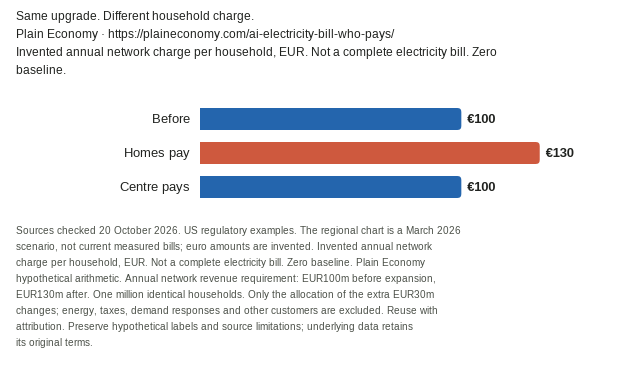
€100 → €130invented annual network charge
€100 → €100if the new user covers the upgrade
2 routesenergy prices and network cost allocation
€30/yearinvented extra household network charge
Local ruleswho pays depends on the system
Not AI alonedata centres run many kinds of services
Check the evidence
Article sources checked:
This is the check date recorded in the article, not a new independent verification or the publication date of every source.
Model results, not measured bills
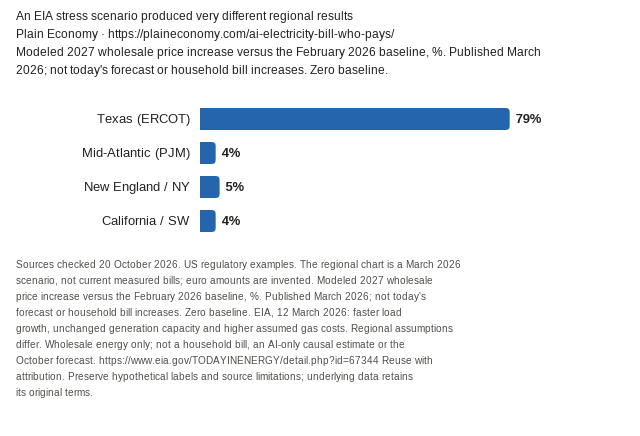
- The EIA chart models 2027 wholesale prices against a February 2026 baseline: Texas +79%, Mid-Atlantic +4%, New England/New York +5%, California/Southwest +4%. Published 12 March 2026, it assumes faster demand, unchanged generation capacity and regional differences. These are not measured household increases or an AI-only effect.
Invented teaching example
- The €100-to-€130 chart invents one million identical homes sharing €30 million of extra annual network costs. It isolates who pays; it does not estimate your electricity bill.
Our interpretation
- A data centre paying for its energy does not settle who finances its grid upgrade. FERC's June 2026 proceedings identify a policy concern; they are not a final nationwide finding that households subsidise AI.
What this cannot establish
- These are US regulatory examples. Data centres serve more than AI, and wholesale prices exclude other household charges. No measured AI surcharge in Spain or any individual home is established.
What would change the assessment?
- For a local claim, an approved tariff linking an identified project's extra costs to household charges would strengthen the case. Enforceable agreements covering those costs and cancellation risks would weaken it. Compare the same household consumption and dates, separating energy, network charges and taxes.
Primary sources and their dates
- EIA: high-demand electricity scenario
Published 12 March 2026; modeled year: 2027; comparison baseline: February 2026.
- FERC: cost transparency and customer protection
Explains June 2026 proceedings and proposed protections; the article does not record a separate page publication date.
- Berkeley Lab: large-load rate designs
Published August 2026; review of tariffs and service agreements, not measured household AI costs.
You never open an AI chatbot. You have not bought an AI subscription. Yet your home and a nearby data centre may use the same electricity network. That connection creates a question that does not appear on the chatbot's price page: who pays when the wires need to get bigger?
Imagine a block of flats with a shared lift. A new business moves upstairs and needs a larger lift. Paying for its own journeys does not settle who pays for replacing the lift. The building could charge the business, share the cost with residents or negotiate a mixture. The analogy is about shared infrastructure, not a description of any country's electricity tariff.
Why could someone who does not use AI pay anything?
A data centre is a building full of computers and equipment that keep them running. Some serve AI; others provide storage, websites, video and ordinary business computing. A figure for all data-centre demand is not a figure for AI alone. Behind an online service are physical machines that need power and cooling.
There are two separate routes to your bill. One is the price of producing electricity: if demand grows faster than available supply, more expensive generators may be needed. The other is infrastructure: new lines, substations and equipment have to be financed and maintained. A centre can pay for every unit it consumes while the rules still assign some shared network costs to other customers.
Your electricity bill is more than the electricity
Think of three envelopes: producing or buying energy; transporting it reliably; and the remaining charges, taxes and supplier costs. Actual bills combine and label these differently. A household also pays for how much it uses, so a hotter summer can raise the total without the same rise in the unit price.
The EIA's October outlook distinguishes wholesale energy prices from the additional costs in residential prices. It also identifies weather and gas prices as important drivers. Consequently, a wholesale price jump is not an equal percentage increase in a household bill. Nor does a rising bill establish that AI caused it.
A EUR30 example shows why the contract matters
In this invented system, one million identical households collectively pay EUR100 million a year for the network: EUR100 each. A new facility requires an upgrade that adds EUR30 million to the annual amount to be recovered. This is an annual cost requirement, not a one-off construction invoice.
If all that extra amount is assigned to those households, their network charge becomes EUR130 each. If the new user covers the extra EUR30 million, the households stay at EUR100. The new user's payment for energy is outside this example. So are taxes, other users and any benefit from spreading existing costs. Neither outcome is a prediction.
Same upgrade. Different household charge.
Invented annual network charge per household, EUR. Not a complete electricity bill. Zero baseline.
See the data
| Case | Network charge per home, EUR/year |
|---|---|
| Before expansion | 100 |
| Homes pay upgrade | 130 |
| New user pays upgrade | 100 |
Credit Plain Economy and the original sources. Keep the caption and example labels. Reuse conditions
The extra EUR30 is EUR2.50 per month. It is not an estimate of an AI charge on a real bill. The example isolates a decision: which customer class is required to cover which cost? In a real network, allocating every upgrade entirely to one customer may also be wrong if other users benefit. The engineering study and tariff have to establish that.
Where is this a real policy question?
In the United States, FERC's explanation of its June 2026 proceedings identifies inadequate cost transparency and possible shifting of large-load connection costs as concerns. It describes proposed protections, not a final nationwide finding or a new uniform retail rate. State commissions decide how federally approved transmission costs reach retail customer groups.
That distinction matters. A national announcement about connecting data centres does not tell a household its next bill. For a specific case, look for the approved local tariff, the upgrade costs and any financial guarantees. A company's promise to pay its way is useful only when the enforceable terms show what it covers.
Why the effect can be large in one region and small elsewhere
Supply, interconnections and timing differ. A March 2026 EIA stress scenario modeled faster electricity demand growth with generation capacity unchanged. Its 2027 wholesale price differences from a February baseline varied sharply by region. The chart reproduces those model results, not measured household increases or the latest forecast.
An EIA stress scenario produced very different regional results
Modeled 2027 wholesale price increase versus the February 2026 baseline, %. Published March 2026; not today's forecast or household bill increases. Zero baseline.
See the data
| Region | Modeled difference, % |
|---|---|
| Texas (ERCOT) | 79 |
| Mid-Atlantic (PJM) | 4 |
| New England / NY | 5 |
| California / SW | 4 |
Credit Plain Economy and the original sources. Keep the caption and example labels. Reuse conditions
A system with room to supply a new user is different from one needing expensive additions immediately. Treating every new data centre as the same shock misses that distinction. These regional percentages are not a ranking of how much AI has added to residents' bills.
Could a new data centre help pay for the grid instead?
Yes. Consider a shared network whose existing costs do not rise much when a new customer arrives. If that customer makes a reliable contribution, more revenue can cover those costs. Whether this offsets new investment and supply pressure is a local calculation, not a universal benefit.
The August 2026 Berkeley Lab review examines large-load tariffs and service agreements intended to manage supply and financial risks. Useful questions include how long the customer commits to pay, what happens if it cancels and whether financial security covers unfinished or underused investments. Large-load growth brings both opportunities and risks.
There is also a timing problem. A network may build for a promised customer that arrives late, uses less than requested or never opens. If the contract does not protect the other customers, the equipment remains but the expected payer is missing. Sharing that risk should be a visible decision.
What would prove that your household is helping pay?
A credible explanation needs a chain of evidence: the identified project, its additional costs, the approved allocation and the effect on the relevant household tariff. Then compare the same consumption and dates, separating energy, network charges and taxes. A map of data centres beside a map of price rises cannot establish that chain by itself.
The US examples here are not evidence of an AI surcharge in Spain, Germany, Japan or any other country. Nor can we calculate a personal AI bill from a global data-centre energy total. The useful question is local and concrete: which costs did the regulator approve, who must pay and who bears the risk if the project changes?
For the separate question of investors paying too much for useful technology, read whether AI can succeed while an investment loses money. For how companies finance the build-out, see Big Tech's AI borrowing.
You do not have to use a service to share its infrastructure. But sharing the wires does not automatically mean subsidising its owner. Follow the tariff and the contract: that is where a provocative headline becomes a question we can actually check.
Sources and scope
- EIA: October 2026 electricity outlook.
- EIA: 12 March 2026 high-demand scenario.
- FERC: cost transparency and customer protection.
- Berkeley Lab: large-load rate designs, August 2026.
Read on 20 October 2026. The euro example is original hypothetical arithmetic. The EIA stress chart uses a dated scenario with regional assumptions, not a causal estimate of AI costs. Educational analysis, not personal investment advice.