
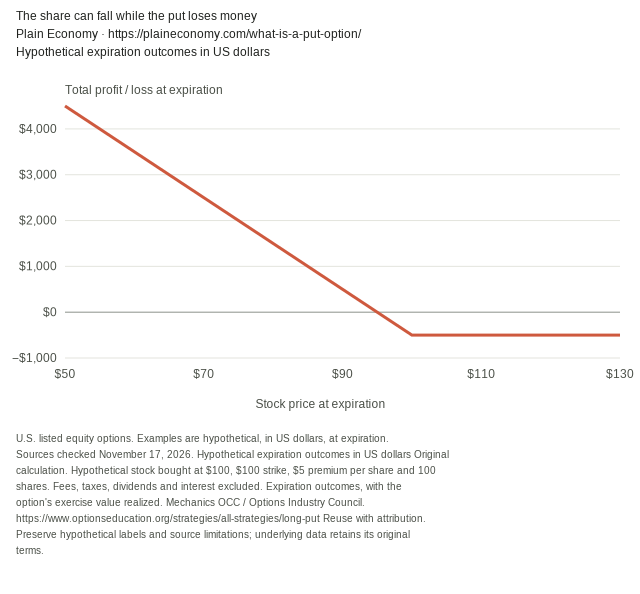
The share can fall while the put loses money
Hypothetical expiration outcomes in US dollars
See the data
| Stock price | Put alone | Shares alone | Shares plus put |
|---|---|---|---|
| $70 | $2,500 | −$3,000 | −$500 |
| $90 | $500 | −$1,000 | −$500 |
| $95 | $0 | −$500 | −$500 |
| $97 | −$200 | −$300 | −$500 |
| $100 | −$500 | $0 | −$500 |
| $120 | −$500 | $2,000 | $1,500 |
Credit Plain Economy and the original sources. Keep the caption and example labels. Reuse conditions
THE IDEA IN ONE LINE
The strike, premium, expiration and existing shares determine what a put can do for its holder.
A right to sell, with a deadline
What are you buying when you buy a put?
Start with the contract's promise. A put's holder may sell the specified underlying at the strike price under its terms. For standard U.S. equity options, one contract usually covers 100 shares. The seller accepts a possible obligation to buy the shares on assignment. Contract adjustments can change the deliverable, so the specification matters. OCC’s definitions
Our example uses an imaginary share worth $100. The put has a $100 strike and costs $5 per share. With a 100-share contract, the premium is $500. The illustration assumes the shares, contract and expiry match exactly. These prices are chosen for teaching and are not a current Nvidia quote.
| Field | Teaching input | What it determines |
|---|---|---|
| Underlying | Imaginary stock | The shares covered |
| Strike | $100 per share | The sale price under the right |
| Premium | $5 per share | $500 for the example contract |
| Multiplier | 100 shares | The size of the example exposure |
| Expiration | The contract’s specified date | The deadline for the right |
What happens if the stock falls, stays flat or rises?
At expiration, the put has exercise value when selling at the strike would beat selling at the market price. At a $70 stock price, that difference is $30 per share, or $3,000 for the example contract. The $500 purchase price leaves a $2,500 net gain before costs. At $100 or $120, the put has no exercise value and loses its $500 premium.
The stock can fall and the option buyer can still lose. A finish at $97 gives the put $300 of exercise value. After the $500 premium, the loss is $200. The example reaches break-even at $95, the strike minus the per-share premium. OCC’s long-put payoff and break-even method
See the calculation
Put profit at expiration = [max(strike − stock price, 0) − premium per share] × shares represented. For a $97 finish, [max(100 − 97, 0) − 5] × 100 = −$200. This assumes the exercise value is realized and excludes fees, taxes and financing.
How does a put protect shares you already own?
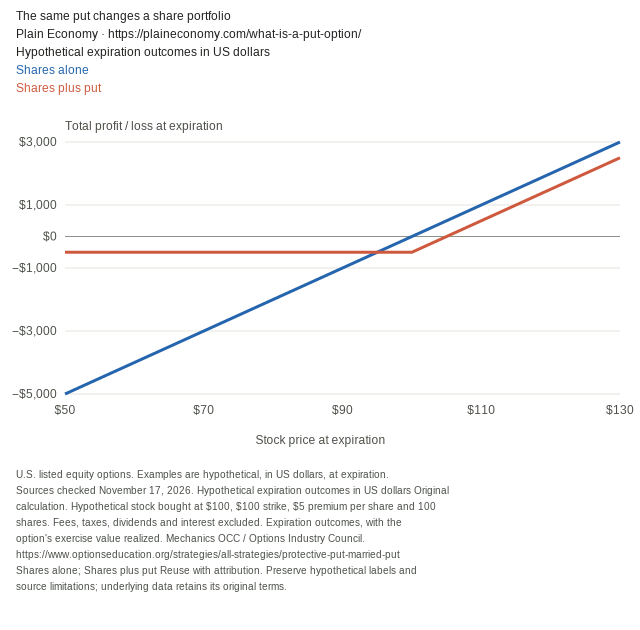
Now give the same buyer 100 shares purchased for $100 each. The shares cost $10,000 and the option costs $500, bringing the initial outlay to $10,500. Below the strike at expiration, the put's exercise value offsets further losses on those matching shares. In our arithmetic, the maximum combined loss is $500 before costs.
The same put changes a share portfolio
Hypothetical expiration outcomes in US dollars
- Shares alone
- Shares plus put
See the data
| Stock price | Put alone | Shares alone | Shares plus put |
|---|---|---|---|
| $70 | $2,500 | −$3,000 | −$500 |
| $90 | $500 | −$1,000 | −$500 |
| $95 | $0 | −$500 | −$500 |
| $97 | −$200 | −$300 | −$500 |
| $100 | −$500 | $0 | −$500 |
| $120 | −$500 | $2,000 | $1,500 |
Credit Plain Economy and the original sources. Keep the caption and example labels. Reuse conditions
At a $70 finish, the shares alone lose $3,000. The option's $2,500 net gain leaves a $500 combined loss. At $120, the shares gain $2,000 and the put loses $500, leaving $1,500. The protection has a cost even when the shares rise. Its scope ends with the contract's life. OCC’s protective-put explanation
If you bought the shares at $110 instead, the same $100-strike put would leave a $1,000 loss between your share cost and the strike, plus the $500 premium. The maximum combined loss would be $1,500 before costs. Buying insurance at today's strike does not erase losses already embedded in your purchase price. This calculation uses the changed share entry price, keeping all option inputs fixed.
Why can the option price behave differently before expiration?
The charts show the final payoff. Before expiration, an option can also have time value. Its market price responds to remaining time and implied , alongside the stock price and strike. It may be possible to sell the option to close the position while that value remains. The executable bid and ask affect the proceeds. OCC’s option-price FAQ
As an announcement passes, a reduction in uncertainty can lower implied volatility. That can pull a purchased option's price down even when the stock moves in the expected direction. The size and timing of the share move matter. A diagram of expiration payoffs cannot reproduce every earlier sale price.
How is buying a put different from selling one?
A buyer pays the premium. A seller receives it and can face an obligation to purchase the shares if assigned. In the same hypothetical contract, the seller receives $500 but could have to buy 100 shares for $10,000. If those shares become worthless, the net loss on the put is $9,500 before costs. That is the strike payment minus the premium received. SEC introduction to option rights and obligations
The buyer's premium limit describes the option investment while held as a long option. Exercise can create a share transaction. For someone who does not own the shares to deliver, exercise may result in a short position and additional exposure. Check the broker's expiration instructions, cut-off time and account permissions before a deadline. OCC on expiration risk
What should you look for in an options headline?
Identify the underlying, strike, expiration, multiplier and premium. Then ask whether the reported activity is buying or selling, opening or closing, and whether the shares are already held. Volume measures contracts traded during a period. Open interest counts outstanding contracts after the relevant clearing process. Neither field supplies the holder's entire portfolio. OCC’s trading and open-interest FAQ
For an actual case, our Nvidia options article examines a reported shift in positioning. Compare the whole portfolio and the price paid before drawing a conclusion from the label “put”.
Download the hypothetical payoff table (CSV) · Download sources, assumptions and observations (JSON)
Continue with our guides to market fear and valuation, large market participants and volume profiles and stop orders.
Scope. This guide concerns the simplified mechanics of listed U.S. equity puts. Cash-settled index options, European-style contracts, adjusted contracts and tax treatment can work differently. The examples use matching shares and assume exercise value is realized at expiration. This guide is educational content.
Keep reading.
Do Nvidia’s put options predict a crash?What are market whales?
Volume profile: support, resistance and stop-losses
All market reports