THE IDEA IN ONE LINE
The same purchased put can protect a shareholder or express a bet on falling prices.
A right to sell, with a deadline
What changed in Nvidia’s option trading?
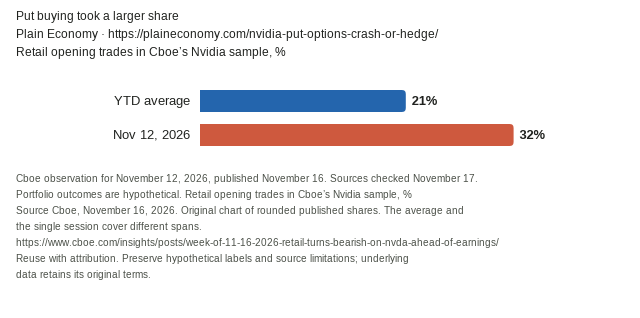
Cboe reported a put-buying share of 32% of retail opening trades in its Nvidia sample on Thursday, November 12, against a year-to-date average of 21%. Subtracting the rounded shares gives an increase of 11 percentage points. These observations cover Cboe’s exchanges and the retail opening-trade classification used in its report. Cboe’s published comparison
For someone holding Nvidia or an AI-heavy fund, the question is whether this changes the risk they already own. The answer needs more than a headline about puts. The trade's size relative to the investor's existing assets matters, as does the price paid for protection.
Nvidia scheduled its results announcement for November 17, 2026, at approximately 1:20 p.m. Pacific, followed by a call at 2 p.m. Pacific. This article examines the positioning reported before that announcement. Company announcement
Can the same put mean two different things?
A put gives its holder a right to sell the underlying shares at a specified price under the contract terms. An investor who owns shares can use that right to limit losses over the option's life. A trader with no shares can buy the same put to seek a profit from a decline. A screen showing the put purchase leaves the existing stock position out of view. OCC’s options basics · Protective-put mechanics
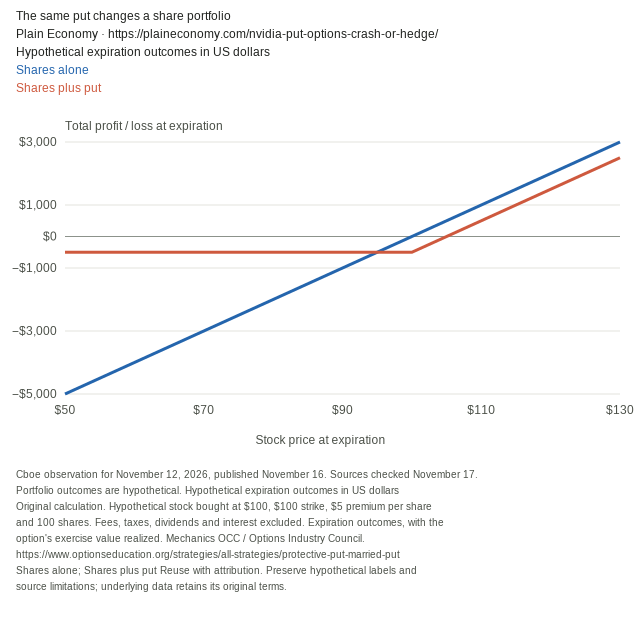
Consider a hypothetical stock at $100. Two investors each buy a put with a $100 strike and a $5 premium per share, representing 100 shares. One also owns 100 shares bought at $100. The other holds only the put. Both pay $500 for their option.
The same put changes a share portfolio
Hypothetical expiration outcomes in US dollars
- Shares alone
- Shares plus put
See the data
| Stock price | Put alone | Shares alone | Shares plus put |
|---|---|---|---|
| $70 | $2,500 | −$3,000 | −$500 |
| $90 | $500 | −$1,000 | −$500 |
| $95 | $0 | −$500 | −$500 |
| $97 | −$200 | −$300 | −$500 |
| $100 | −$500 | $0 | −$500 |
| $120 | −$500 | $2,000 | $1,500 |
Credit Plain Economy and the original sources. Keep the caption and example labels. Reuse conditions
If the stock finishes at $70, the put's exercise value is $3,000. Subtract the $500 premium and the option alone has gained $2,500. The shareholder also has a $3,000 share loss, leaving a combined loss of $500. At $120, the standalone put loses $500, while the protected share portfolio gains $1,500. These are expiration calculations, excluding trading costs. They describe different exposures behind an identical option purchase.
What would establish a record?
A claim of a record needs a historical series with a consistent universe and classification. Ask whether the measure is contracts, premium paid, share-equivalent exposure or a ratio. Check whether it captures purchases that open positions, sales, closing trades or all activity combined. Comparisons across expirations can also mix immediate event risk with positions lasting much longer.
Cboe's opening and closing classifications distinguish actions and participant categories. Its data description identifies the exchanges covered. A total-market volume feed and a retail opening-trade sample answer different questions. Cboe Open-Close Volume Summary specification
The “record” claim remains unverified. We have not obtained a comparable full-history series that establishes it. We also have no account-level evidence identifying a trader's complete portfolio or proving that a trader possessed private information.
Why can protection become expensive before results?
An announcement can resolve uncertainty abruptly. An option's premium depends on its remaining life and the uncertainty priced into it as well as the stock price and strike. After an event, a fall in implied can reduce a long option's value, all else equal. Someone buying protection is therefore paying for a particular contract at a particular moment. OCC on option-price behaviour
A visible put purchase does not tell a shareholder whether the quoted insurance price suits their own holding period. Repeatedly renewing protection adds recurring premiums. The payoff chart above isolates a single purchase through expiration, with fixed inputs. It does not calculate a long-run return from buying puts.
What should an investor check after the announcement?
Compare the reported results and guidance with the expectations being used, then keep the time windows consistent when examining the stock and the option. A closing stock price, an intraday option quote and prior-day open interest can describe three different moments. Open interest is the remaining contracts, while volume counts trading during a period. OCC’s volume and open-interest explanation
For a reader deciding whether their own portfolio is too concentrated, the useful calculation is the possible loss across the whole holding. Read the option contract and its cost alongside that exposure. Large option trades can prompt a question, but copying them without the rest of the position leaves the question unanswered.
Download the hypothetical payoff table (CSV) · Download sources, assumptions and observations (JSON)
Learn the contract from the start in our beginner’s guide to puts. Our earlier Nvidia footprint case study examines executed share volume, a different dataset.
Continue with our guides to market fear and valuation, large market participants and volume profiles and stop orders.
Research note. This article takes its question from Cava’s Nvidia video of November 16. Its transcript and chart dataset were unavailable for this review. Figures and conclusions here come from the primary sources linked above and the labelled original calculation. The raw Cboe trade counts and full historical record were unavailable.
Keep reading.
What is a put option and how does it work?Can you tell when big investors are buying?
Fear & Greed Index: opportunity or a warning?
All market reports