THE IDEA IN ONE LINE
Follow the decision, the payment it changes and the date it takes effect.
A vote. A law. A household bill.

3 Jan 2027New congressional terms begin
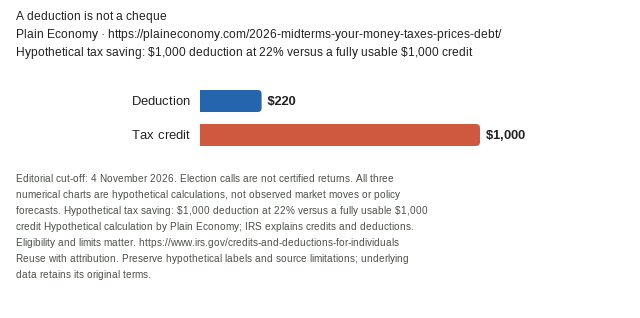
$220Hypothetical saving on a $1,000 deduction at 22%
An election can change who negotiates your taxes without changing next month's payslip. It can move bond prices before any law changes. And it can promise cheaper groceries without making the shopping basket cheaper. To understand the 2026 result, follow the route from a political decision to a household bill.
What do we know about the election result?
At this article's 4 November editorial cut-off, ABC's AP-powered results page reports Democratic majorities in the House and Senate. These are media calls, not certified final returns. We do not publish a final seat tally here. Donald Trump remains president: the result points to divided government when the new Congress takes office.
Election source: ABC's live results using Associated Press data, read 4 November 2026
Congressional terms begin on 3 January 2027. The outgoing Congress still acts before then. The president retains a veto; overriding it requires two-thirds support in each chamber. Controlling Congress therefore brings leverage over legislation, not an unrestricted ability to implement campaign promises.
National Archives: Twentieth Amendment, congressional terms
National Archives: presidential veto and congressional override
Will my taxes change because Democrats won Congress?
A party majority is not a new tax schedule. A proposed change must become law and specify whom it covers and when it applies. A law can use a future effective date or sometimes apply retroactively. Read the enacted text and IRS guidance, not just a campaign announcement. Federal income tax also differs from payroll taxes, state taxes and local taxes.
A useful existing reference: the IRS lists a $16,100 standard deduction for a single filer for tax year 2026. That amount was already set before this election. It reduces taxable income; it is not a $16,100 payment. Filing a 2026 return in 2027 does not turn those rules into a benefit caused by November's result.
IRS: existing 2026 standard deductions and individual tax provisions
In our hypothetical example, an additional $1,000 deduction entirely within a 22% marginal bracket saves $220 of federal income tax. A fully usable $1,000 tax credit saves $1,000 instead. Actual credits may be limited or non-refundable. Neither example is an announced post-election policy.
A deduction is not a cheque
Hypothetical tax saving: $1,000 deduction at 22% versus a fully usable $1,000 credit
See the data
| Scenario | USD |
|---|---|
| Deduction | $220 |
| Tax credit | $1,000 |
Credit Plain Economy and the original sources. Keep the caption and example labels. Reuse conditions
Will groceries, petrol and rent get cheaper?
A result is not a price cut. Food, energy and housing depend on supply, demand, transport, wages and other costs. Policy can influence those forces, with different delays. Slower means prices rise more slowly; a broad fall in prices would be . Neither outcome follows automatically from the colour of the congressional majority.
Consider a separate hypothetical household budget: a $40 monthly tax saving is offset by a 2% increase in a $2,000 monthly spending basket. Both equal $40. This is arithmetic, not an estimate of how a tax cut changes inflation. Your own spending mix, wages and eligibility determine the result for your household.
Why prices can remain high when inflation falls
are one policy channel to watch. US customs collects import duties; the economic burden can be shared through importer margins, supplier prices and customer prices. A tariff reduction need not produce an equal retail-price reduction. Congress has delegated important tariff powers to the president, so a change in congressional control does not automatically remove existing tariffs.
Congressional Research Service: delegated tariff powers, updated 19 March 2026
US Customs and Border Protection: import duties and fees
Who pays a tariff, and how can it reach consumers?
Does a new Congress mean cheaper mortgages?
Congress does not vote on tomorrow's mortgage rate. The makes monetary-policy decisions under its statutory mandate. Mortgage lenders also price longer-term funding, expected inflation, uncertainty and mortgage-specific risks. A change in the Fed's overnight rate does not guarantee an equal change in a 30-year mortgage rate.
Federal Reserve: independence within government
Federal Reserve: policy goals and the transmission to borrowing costs
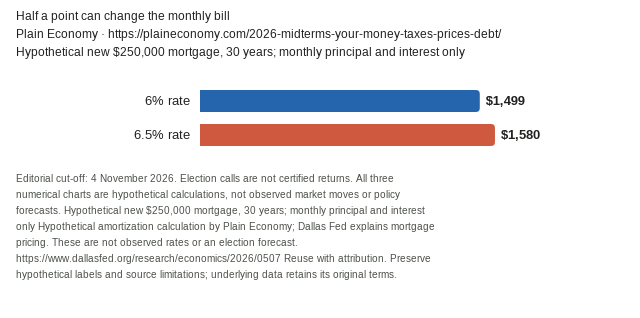
Half a point can change the monthly bill
Hypothetical new $250,000 mortgage, 30 years; monthly principal and interest only
See the data
| Scenario | USD |
|---|---|
| 6% rate | $1,499 |
| 6.5% rate | $1,580 |
Credit Plain Economy and the original sources. Keep the caption and example labels. Reuse conditions
The example adds about $81 a month, or $976 over twelve payments, when a new loan's rate rises from 6% to 6.5%. It excludes fees, insurance and property taxes. An existing fixed-rate borrower's contractual principal-and-interest payment does not reset just because market change. Taxes and insurance can still change the total bill; adjustable-rate loans follow their own reset terms.
Why a cheaper house can still be expensive to finance
How does US government debt reach my pocket?
Three questions often get mixed together: new borrowing to cover a deficit, refinancing debt that matures, and the interest paid on debt. Refinancing $1 trillion does not by itself mean a $1 trillion increase in net debt. And a higher market yield does not instantly reprice every outstanding fixed-coupon bond's interest payment.
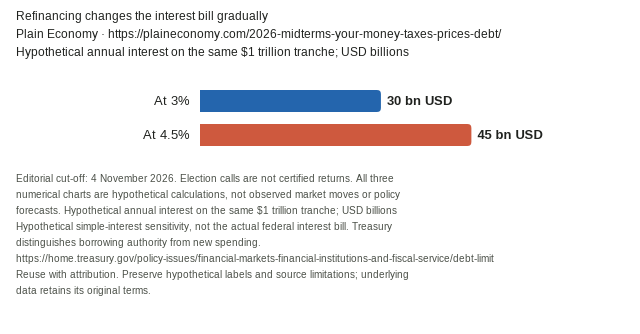
Refinancing changes the interest bill gradually
Hypothetical annual interest on the same $1 trillion tranche; USD billions
See the data
| Scenario | USD billions per year |
|---|---|
| At 3% | 30 bn USD |
| At 4.5% | 45 bn USD |
Credit Plain Economy and the original sources. Keep the caption and example labels. Reuse conditions
In this separate hypothetical example, rolling a $1 trillion tranche from 3% to 4.5% raises its interest cost from $30 billion to $45 billion: $15 billion more. It is not a forecast, an actual Treasury schedule or the government's full interest bill. Real costs depend on the mix of maturities, new deficits, floating-rate and inflation-linked debt, and financing conditions.
A larger interest bill can put pressure on choices about taxes and services. It does not identify which household will pay more, or prove that bond yields must rise after this election. Growth, inflation expectations, global demand for safe assets and the credibility of fiscal plans also matter. A budget fight, a government shutdown and a debt-limit impasse are different problems. Treasury says raising the debt limit finances existing obligations rather than authorizing new spending.
Treasury: what the debt limit does and does not authorize
How to distinguish Treasury refinancing from a financing crisis
What should I watch next?
Follow an enacted law's eligibility rules and effective date for taxes; inflation and wage releases for ; and actual loan quotes and contracts for financing costs. For fiscal news, distinguish new deficit projections from gross refinancing needs. A market's first reaction measures changing expectations, not the final effect on jobs or household budgets. Check what was already expected and what else happened that day.
If you live outside the United States, the effects are mainly indirect: the dollar, energy prices, demand for exports and global financing conditions. A US tax proposal does not normally change a Spanish household's income-tax bill. Currency moves can also change the euro value of a dollar asset, independently of its dollar return.
The useful question is not whether the winning party is good or bad for your money. Ask which decision could change which payment, for whom, and from what date. That makes the next headline something you can check.
Follow the next official economic releases
Download the hypothetical inputs, formulas, sources and limitations (JSON)