THE IDEA IN ONE LINE
The minimum shrinks as you pay. Stop the payment from shrinking and most of the cost disappears.

One line on your bill hides sixteen years of payments.
16.5 yearsto clear $5,000 at the minimum
$7,811interest paid along the way
$3,158interest if the first payment stays fixed
16.5 yearsto clear $5,000 paying only the minimum
$7,811interest on that path
4.8 yearsif the first payment stays fixed
This article is laid out like the bill it explains. Read the statement first, then follow each numbered line to its note.
Example Card
Hypothetical example, not a real account
Minimum Payment Warning
If you make only the minimum payment each period, you will pay more in interest and it will take you longer to pay off your balance.
Plain Economy calculation. The warning's wording and the layout of the table follow the US rule for card statements; a real statement would round the first estimate to the nearest whole year.
1. What rate does a credit card really charge?
About 22% if you carry a balance. The Federal Reserve's preliminary August 2026 figures from commercial banks put the average at 22.36% on accounts charged interest, and 21.19% across all accounts. We use the first figure, since this example carries a balance every month. Your own card's rate is on your statement and may be much higher or lower.
The balance in the example is ours, not an average. For scale, Americans owed $1.26 trillion on credit cards at the end of June; the New York publishes its September figures on 10 November.
2. What's inside a $143.17 minimum payment?
Mostly interest. Issuers set their own formulas, and the rule requires each statement's estimates to use the formula that applies to that account. Ours is the greater of $35 or 1% of the balance plus the month's interest, the shape used in research on US card accounts. In the first month that means $93.17 of interest and $50.00 of debt repaid, so 65% of the payment goes on interest.
After a full year of payments totalling $1,626.60, you still owe $4,431.92. Only $568.08 of what you paid reduced the debt.
3. Why does a $5,000 balance take 16.5 years?
Because the minimum falls with the balance. Each month you owe a little less, so next month you are asked to pay a little less, and the debt shrinks ever more slowly. The bill feels lighter while the finish line moves away.
| Month | Payment | Interest | Debt repaid | Balance left |
|---|---|---|---|---|
| 1 | $143.17 | $93.17 | $50.00 | $4,950.00 |
| 12 | $128.19 | $83.42 | $44.77 | $4,431.92 |
| 24 | $113.62 | $73.94 | $39.68 | $3,928.37 |
| 60 | $79.12 | $51.49 | $27.63 | $2,735.76 |
| 120 | $43.29 | $28.17 | $15.12 | $1,496.89 |
| 180 | $35.00 | $9.96 | $25.04 | $509.52 |
| 198 | $4.94 | $0.09 | $4.85 | $0.00 |
It takes 69 months, nearly six years, to repay the first half. The $35 floor only takes over in month 142, which is what finally brings the end in sight. By then you are nearly twelve years in. In total you pay $12,810.98: the $5,000 plus $7,810.98 of interest, more than one and a half times the original debt.
4. What saves more: a lower rate or a steady payment?
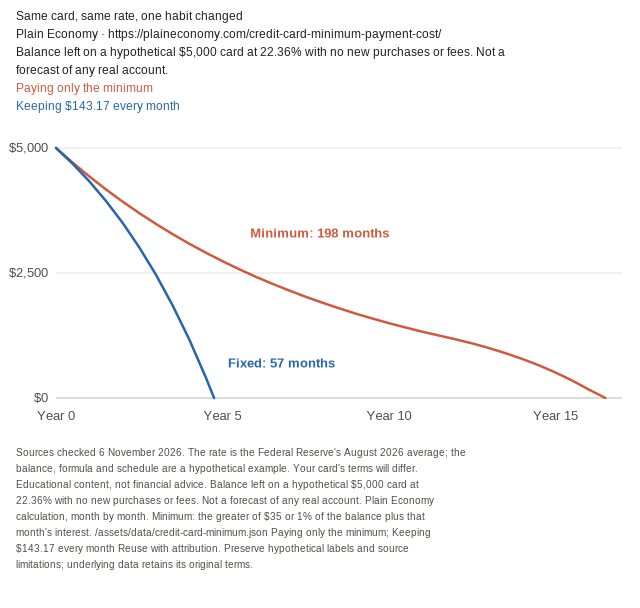
In this example, the steady payment. That is the surprise in the numbers. If your rate were cut in half but you kept paying the falling minimum, you would pay $3,643.17 in interest over 14.3 years. If your rate stayed at 22.36% and you simply kept paying the first $143.17 every month, you would pay $3,157.77 over 4.8 years.
Same card, same rate, one habit changed
Balance left on a hypothetical $5,000 card at 22.36% with no new purchases or fees. Not a forecast of any real account.
- Paying only the minimum
- Keeping $143.17 every month
See the data
| Monthly payment | Rate | Months | Years | Total interest |
|---|---|---|---|---|
| Minimum | 22.36% | 198 | 16.5 | $7,810.98 |
| Minimum | 11.18% | 172 | 14.3 | $3,643.17 |
| Fixed $143.17 | 22.36% | 57 | 4.8 | $3,157.77 |
| Fixed $191.88 | 22.36% | 36 | 3.0 | $1,907.77 |
| Fixed $286.34 | 22.36% | 22 | 1.8 | $1,105.13 |
Credit Plain Economy and the original sources. Keep the caption and example labels. Reuse conditions
No extra money is needed in the first month: the payment is the same one the bill already asks for. It only feels larger later, when the minimum would have dropped. US statements must also show the monthly payment that clears the balance in three years, here $191.88, which brings the interest down to $1,907.77.
How many people pay only the minimum?
More than a quarter of accounts, in the best large study we found. Keys and Wang, using data on a quarter of the US general-purpose card market, found that 29% of accounts regularly pay at or near the minimum. The paper dates from 2016, so treat the share as a guide, not a current count.
Many of those people have no choice in a given month, and paying the minimum still avoids a missed payment. But money is not the whole explanation. The same study estimates that at least 9% to 20% of all accounts respond to the printed number more than a shortage of cash alone would explain. The minimum acts as a suggestion, and people anchor on it.
Does the warning on the statement work?
Only a little. The box at the top of this page has been required on US statements since the CARD Act of 2009. Keys and Wang found that fewer than 1% of accounts adopted the suggested three-year payment. They estimate savings of $62 million a year, against more than $2 billion had every anchored cardholder switched.
Knowing the cost, it seems, does not change the number people type into the payment box. A practical alternative is a fixed automatic payment, set once, so the falling minimum never gets a vote.
How do I check this on my own card?
If you are in the US, find the Minimum Payment Warning on your latest statement. It already gives your own years and total cost, using your own formula. Then note this month's minimum and ask whether you could keep paying that amount as it falls. If that is out of reach, any fixed amount above the falling minimum still helps.
Elsewhere, the box may not exist, but the arithmetic does. In the EU, new consumer credit rules apply from 20 November 2026 and require countries to act against excessive rates. Spain's draft law includes caps that would cover revolving cards; the Banco de España says it is still a draft. On a European revolving card, look for the rate and for how the monthly instalment is calculated.
Whether paying down a card beats saving or investing is a separate question, but an interest rate near 22% is hard to out-earn. Our comparison of saving more against earning more shows how to frame the choice, and our mortgage example shows how rates change a monthly payment on a much longer loan.
What does this example leave out?
New purchases, fees, late charges and rate changes, all of which would make the real path worse or at least different. US disclosures make similar simplifying assumptions. The formula matters too: with a $25 floor the schedule lasts 231 months rather than 198, and with 2% of the balance plus interest it lasts 121. A promotional rate or a balance transfer would change the sums again, usually with fees and an end date attached.
Method: monthly interest is the rate divided by twelve, applied to the balance after the previous payment and rounded to the cent. The rate is an average from a bank survey, and the US rules and research cited do not describe every card or country. This is educational content, not financial advice. If debt is becoming hard to manage, a non-profit credit counsellor can review your options.
Download the schedule and method (JSON) · Download the comparison (CSV)
Keep reading.
Save €100 more or earn one percentage point more?House prices fall. Why can buying cost more?
Your pay went up. Can you buy more?
All market reports